Why am I paying €40 for electricity when I have solar panels?
Why am I paying €40 for electricity when I have solar panels?
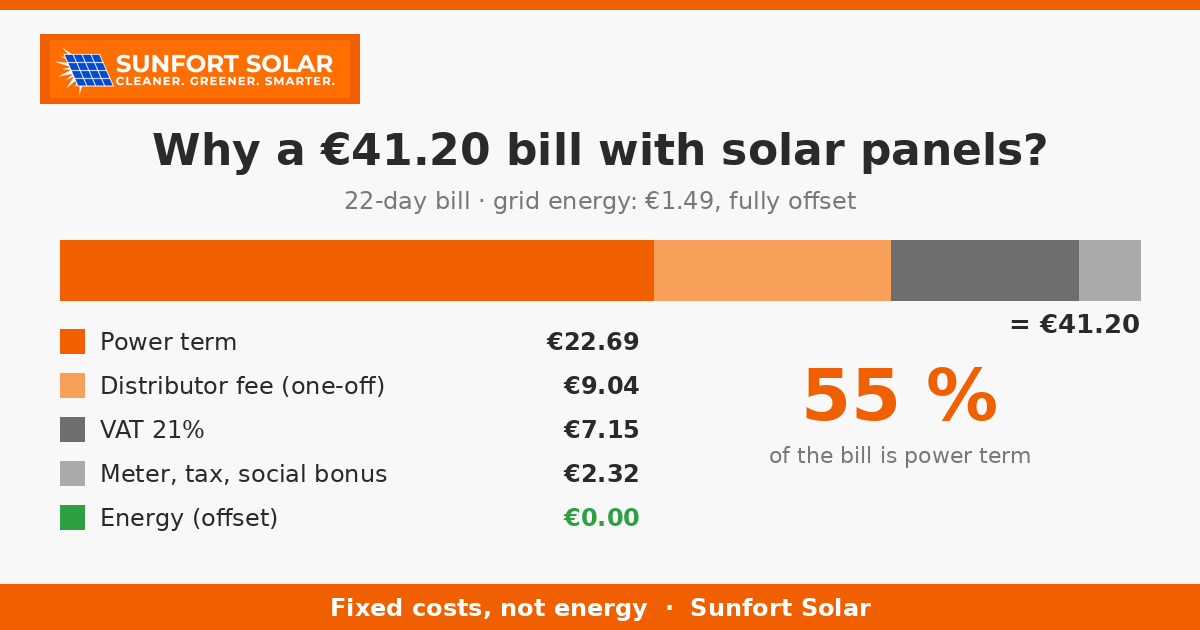
You have solar panels, the sun shines on your roof every day, your system exports hundreds of kWh to the grid… and then a bill for €41.20 arrives. Your first thought is that something must be wrong. In most cases, though, the system is working perfectly: what weighs on the bill is not the energy, but everything around it.
Let’s look at a real case from one of our customers in the Alt Empordà (anonymised, of course): a house with solar PV and surplus compensation, and a 22-day bill.
The bill, line by line
| Item | Amount |
|---|---|
| Energy bought from the grid (12.9 kWh) | €1.49 |
| Surplus compensation (462 kWh × €0.03/kWh, capped) | −€1.49 |
| Power term (P1 6 kW, P2 8.8 kW) | €22.69 |
| Distributor service fee (“derechos de actuación”, one-off) | €9.04 |
| Meter rental | €0.59 |
| Electricity tax | €1.19 |
| Social bonus financing | €0.54 |
| VAT (21%) | €7.15 |
| Total | €41.20 |
In 22 days this house bought only 12.9 kWh from the grid: €1.49. Everything else it produced and used itself. So the energy part ends up at zero. The €41.20 is almost entirely made up of costs you would pay even if you used no electricity at all.
Surplus compensation has a ceiling
The system exported 462 kWh. At €0.03/kWh that would be €13.86 of compensation. Yet the bill shows only €1.49. Why?
Because the rules say so. Spain’s Royal Decree 244/2019 (article 14), which governs self-consumption with simplified compensation, states that the value of the surplus energy can never exceed the cost of the energy taken from the grid in that billing period. In other words: compensation can bring the energy term down to zero, but it cannot be deducted from the power term, the meter rental or taxes, and whatever is left over is neither paid out nor carried forward to next month.
In this case, about €12.37 worth of surplus was simply lost. It is not a mistake by the supplier: this is how simplified compensation works.
What’s left: the fixed costs
Power term: €22.69
The biggest item, more than half the bill. You pay to have a certain power available, whether you use it or not. The formula is:
contracted kW × price per kW per day × days in the billing period, for each period (P1 and P2).
This house has 6 kW in P1 (peak and mid-peak) and 8.8 kW in P2 (off-peak). Over 22 days that adds up to €22.69. With solar panels, daytime use is covered by the sun, and the contracted power was often chosen years ago, before self-consumption.
Distributor service fee: €9.04 (one-off)
This is charged by the distribution company when it has to act on your supply, for example after a contract change (registering self-consumption, changing power or account holder). It is regulated by Royal Decree 1048/2013 (article 29) and usually appears only once. The next bill will not include it.
Meter rental, electricity tax and social bonus: €2.32
- Meter rental (€0.59): if the meter belongs to the distributor, you pay for it every day.
- Electricity tax (€1.19): a percentage (currently 5.11%) applied to power and energy.
- Social bonus financing (€0.54): a fixed daily contribution paid by every contract.
VAT: €7.15
21% is applied to the whole sum above. The higher the fixed costs, the more VAT you pay.
What you can do to pay less
1. Check your contracted power
This is where the biggest margin is. Look at your real consumption peaks: the distributor keeps this data (in its customer portal, or via the maximum-demand reading of your smart meter). If you never go above 4 or 5 kW, paying for 6 kW in P1 and 8.8 kW in P2 every day makes no sense. Lowering it by 1 or 2 kW shows up on every bill, all year round.
A word of caution: set it too low and the power limiter trips when the oven, washing machine and heat pump run at the same time. Base the decision on data, not guesswork. (And bear in mind that changing the power may trigger a one-off service fee.)
2. Use your surplus instead of giving it away
If you have hundreds of spare kWh every month and the compensation hits the cap, those kWh are worth nothing. There are two ways out:
- A physical battery: store the midday surplus and use it in the evening, instead of selling it at €0.03/kWh and buying it back later at a much higher price.
- A virtual battery: some suppliers bank the surplus that does not fit on the bill as a euro balance and deduct it in later months (in some cases even from the power term). Read the conditions carefully: monthly fee, balance expiry and energy price.
3. Review the compensation price and your tariff
€0.03/kWh is a low price. Depending on the supplier and the type of tariff (fixed or indexed), surplus can be paid at a different rate. Compare offers by looking at the total, not just the energy price: what you gain on compensation you can lose on a more expensive power term. We explain how in how to choose an electricity provider.
4. Don’t panic about one-off charges
The €9.04 service fee will not come back. Without that line, this same bill would have been around €30, and with adjusted contracted power it would drop further.
Conclusion
With solar panels, your electricity bill depends far less on how much you use and far more on the fixed costs: power, meter, taxes and VAT. The system in this case does exactly what it should, because the energy part is at zero. The remaining savings are in your contracted power and in making better use of your surplus.
Want to know whether you are paying more than you need to? At Sunfort Solar we review your bill, look at your power peaks and tell you what is worth changing. Get in touch and we’ll take a look.