Heating and cooling the whole house with one machine: heat pump, fan coils and zones
Heating and cooling the whole house with one machine: heat pump, fan coils and zones
A few days ago we prepared a quote for a house in the Alt Empordà where the owners wanted heating and cooling in every room. The first idea was the classic one: a ducted unit for the main floor and a split for the room that sits apart. But the client asked whether it could all be done with a single machine outside. It can, and we prepared both options so they could compare them.
Today we explain the difference between the two, what you gain with each and when one or the other makes sense.
Two ways of taking heating and cooling to each room
The difference lies in what flows through the house.
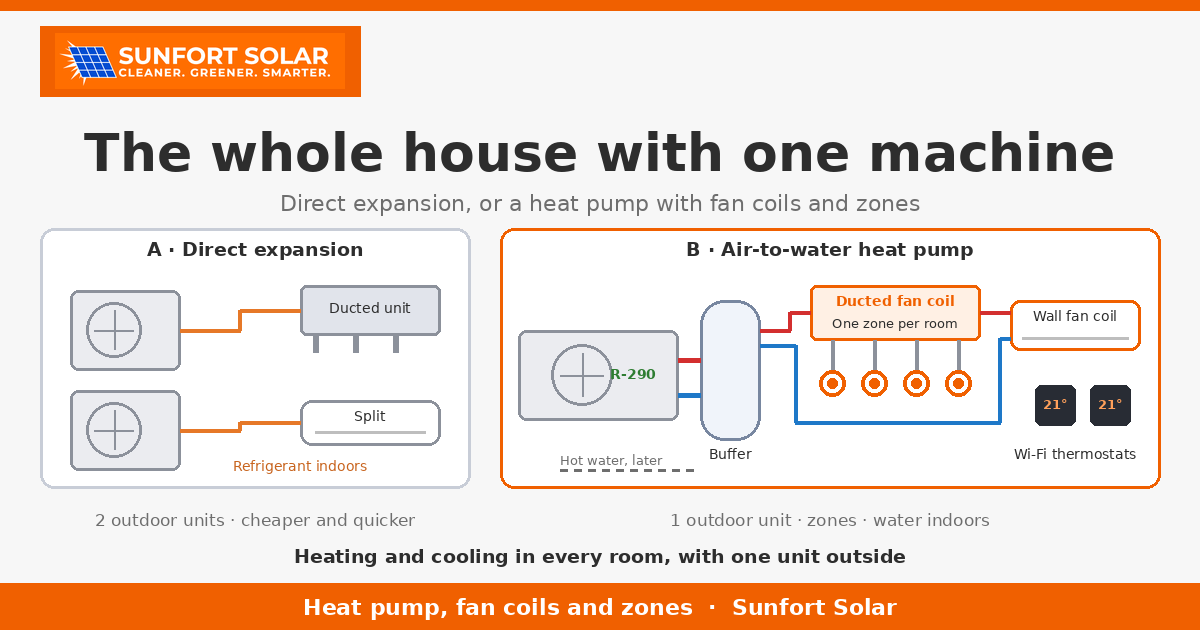
- Option A, direct expansion: what runs through the pipes is refrigerant gas. The outdoor unit compresses it and sends it straight to the indoor units, which heat or cool the air. This is how ordinary air conditioners work.
- Option B, hydronic (air-to-water heat pump): the outdoor unit heats or cools water, and that water is distributed through the house to the indoor units, the fan coils, which use a fan to draw the heat or cold out of it.
Option A: ducted unit and split
A ducted unit hidden in the false ceiling distributes air through the grilles in each room, and a wall-mounted split covers the room the ducts do not reach. Each one has its own outdoor unit.
The good points:
- It is cheaper and takes fewer hours to install.
- It is a very well-known, efficient technology with spare parts everywhere.
- There is no water circuit: nothing to bleed or fill.
What to bear in mind:
- Two outdoor units (or more), each needing its own spot on the façade or roof, and each making its own noise.
- The refrigerant runs inside the house. It works well, but it is a circuit that has to be done carefully and is not easy to extend.
- Zoning: a ducted system can be zoned with motorised dampers, but that is a separate system that has to be added.
- No hot water. Domestic hot water still depends on another appliance.
Option B: heat pump, buffer tank and zoned fan coils
This is the system we proposed as the alternative:
- A single air-to-water outdoor unit using R-290 (propane) refrigerant.
- A buffer tank: a small water tank that acts as a “lung”. It stops the machine switching on and off constantly when only one room is calling for heat or cooling, and helps it through defrost cycles in winter.
- A multi-zone ducted fan coil in the false ceiling: a single unit that uses motorised dampers to send air through round outlets to each room. Every room has its own Wi-Fi thermostat, and only the zone that is calling opens.
- A wall fan coil for the room the ducts do not reach, connected to the same water circuit.
The good points:
- One machine outside for the whole house.
- Real zoning: each room at its own temperature, controlled from your phone, and empty rooms are not heated or cooled.
- Ready for hot water. The same heat pump can produce domestic hot water later on by adding a cylinder and a three-way valve, and can even feed underfloor heating or low-temperature radiators.
- R-290, a refrigerant with a very low climate impact. Its global warming potential (GWP) is 3, compared with 675 for the R-32 used in most direct-expansion units. European regulations are steadily restricting high-GWP refrigerants, and propane is where the industry is heading. In monobloc units, the refrigerant also never leaves the outdoor unit: only water goes into the house.
- It works very well with solar panels. With the buffer tank, and later a hot-water cylinder, you can use the midday surplus to heat or chill water.
What to bear in mind:
- More installation work. The whole water circuit has to be built: pipes, pumps, expansion vessels, valves, filling and bleeding the air so no bubbles are left.
- Insulation and condensate. In summer, chilled water circulates at around 7–12 °C. All pipes must be properly insulated so they do not sweat, and each fan coil needs its own drain.
- Space. The buffer tank takes up room, and the ducted fan coil needs a deep enough false ceiling.
- A higher upfront investment. There is more material and considerably more installation time. In our case, the hydronic option came out clearly more expensive than the ducted unit and split, mainly for those two reasons.
- Water maintenance: from time to time the circuit pressure has to be checked and the filters cleaned.
When each option makes sense
Direct expansion (A) is usually the better choice if:
- You only want to heat and cool a few rooms or a single floor.
- The budget is tight and you want the quickest solution.
- Your hot water is already sorted and you do not plan to change it.
A hydronic heat pump (B) makes more sense if:
- You want the whole house on one machine, with room-by-room control.
- You have an oil or gas boiler, or an electric water heater, that you want to retire at some point, and you would like the same machine to make your hot water.
- You have solar panels, or plan to install them, and want to make more use of their energy.
- There is space for the tank and a false ceiling for the ducts.
- It is a long-term home, where the upfront investment is spread over many years.
Grants for renovations
When a fuel-fired heating system is replaced by a heat pump in an existing home, there may be financial support. In Spain the most common are Energy Saving Certificates (CAE), which let you sell the energy saving achieved, and income tax (IRPF) deductions for energy-efficiency improvements, while the scheme is in force. Each has its own conditions, such as energy performance certificates before and after the work, and the amounts depend on the case. When we prepare the quote, we tell you which ones may apply to you.
Our recommendation
There is no single best option for everyone. If you are after a quick, affordable solution for a few rooms, direct expansion is hard to beat. If you want to heat and cool the whole house, with zones, with an eye on hot water and solar panels, a heat pump with fan coils is the foundation of a system you can keep extending.
At Sunfort Solar we install both systems in the Alt Empordà, and we combine them with solar PV so that your heating and cooling run on your own sun as much as possible. Get in touch and send us the plans or a few photos of the house: we will prepare both options so you can compare them.