Your solar system says “off-grid”: what it means and what to check
Your solar system says “off-grid”: what it means and what to check
It’s a message we get often, and even more so from holiday lets and from owners who live abroad: “The solar app says off-grid. The fridge works, but the cooker doesn’t. What’s going on?” Sometimes the alert arrives by email on the other side of Europe, and whoever is at the house doesn’t know whether to call someone or wait.
The good news is that, in most cases, the system is doing exactly what it should. What you need is to understand why it happened and to know what you can check before calling. Here it is, step by step.
What “off-grid” means
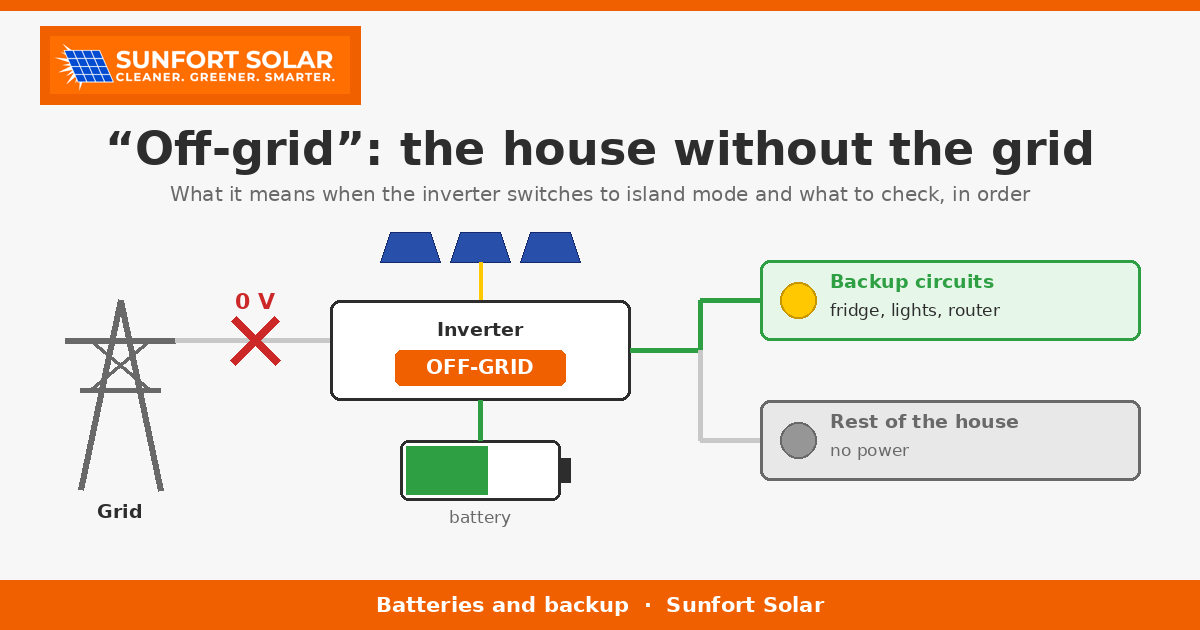
A hybrid inverter has a grid input: the cable that connects it to the house’s distribution board and, through the meter, to the electricity network. When there is no voltage on that input, the inverter detects it within a fraction of a second and must disconnect from the grid for safety reasons.
If the installation has backup (an emergency power circuit), the inverter doesn’t shut down: it switches to island mode, also called off-grid. From that moment on, it only powers the backup circuits, using energy from the battery and, during the day, from the panels. The rest of the house has no power.
That’s why the typical symptom is this: the fridge, a few lights and the router work, but the cooker, the water heater or the air conditioning don’t. It isn’t an inverter fault: it’s the backup doing its job. (If your installation has no backup, the inverter shuts down completely in this situation. We explain this in Battery with backup: why we always recommend it.)
In the app, depending on the brand, you’ll see an “Off-Grid” or “no grid” status, grid voltage at 0 V, grid power at 0 W and the energy-flow diagram with the grid line cut. And the battery going down.
The key question: is it the grid or your house?
All the inverter knows is that no voltage is reaching it. It doesn’t know why. There may be no power in the street, or a switch between the meter and the inverter may have tripped. Checking in order saves calls and call-outs.
1. Is there a power cut in the street?
This is the first thing to rule out:
- Do the neighbours have power? Are the street lights on?
- The distribution company has a fault phone line and website; the number is on your electricity bill. There you can check or report whether there is an outage in the area.
If it’s a power cut, you don’t need to do anything. When the supply comes back, the inverter will detect it and reconnect on its own. It doesn’t do so instantly: it first checks for a while that the grid is stable, so it’s normal for it to take a few minutes to leave island mode.
2. Has the main switch or an RCD tripped?
If the neighbours have power, look at the house’s distribution board. If the main switch or the RCD upstream of the inverter’s line has tripped, the inverter has no grid even though there is power in the street.
You can try switching it back on once. If it stays on, great: the inverter will reconnect after a few minutes. If it trips again straight away, don’t keep trying: there’s a fault on some circuit (an appliance, a wet socket, a cable) and it has to be found. Before trying again, switch off or unplug the large appliances and, if in doubt, let us know.
3. Has the meter cut the supply?
If the house has drawn more power than the contracted power, the smart meter may cut the supply. This mainly happens when the cooker, the oven, the water heater and the air conditioning are on at the same time. In that case, reduce consumption (switch off the large appliances) and follow your distribution company’s instructions to restore it. If it happens often, your contracted power may need reviewing: see how much contracted power you really need.
4. Has the inverter’s protection tripped?
In many installations, the line from the house’s board to the inverter’s grid input has its own circuit breaker, often in a small box next to the inverter. If the house has power but the inverter still says off-grid, this is the main suspect.
Same rule: you can switch it back on once. If it trips again, don’t keep trying and call us.
5. The grid is there, but the inverter won’t accept it
Sometimes the app shows grid voltage (for example, close to 253 V) and the inverter still won’t connect. In that case it’s not that there’s no grid: the voltage or frequency is outside the limits the inverter is allowed to work with. This is more common at the end of a line and during hours of high solar production. The app will usually show an alarm code. We explain this in the inverter disconnects due to grid overvoltage.
While you’re in island mode
Until the grid comes back, the house runs on the battery and the panels. A few things worth knowing:
- Save battery, especially at night. A fridge, a few lights and the router use little; an induction hob, a water heater or an air conditioner drain the battery very quickly.
- Don’t overload the backup. The backup output has a power limit. If more load is connected than it can handle, the inverter protects itself and shuts down, and then you have nothing.
- During the day, the panels recharge. With common hybrid inverters, the panels keep producing in island mode and refill the battery. A long power cut on a sunny day is much easier to get through than one at night.
- Never open the inverter or touch the panel connectors. The panel side is direct current, and it’s dangerous even when the house has no power.
When to call
Contact your installer if:
- the main switch, an RCD or the inverter’s protection trips again after you have reset it once;
- the grid is back (the neighbours and the rest of the house have power) and, after half an hour, the inverter is still off-grid;
- the app shows an error code that isn’t simply the missing grid;
- there is a burning smell, an unusual noise or heat at the inverter, the battery or the board. In that case, don’t touch anything and call straight away.
Send us a screenshot of the app (the status and the alarms screen) and, if you can, a photo of the distribution board. It saves us a lot of time.
If you don’t live in the house
For owners who live abroad and for holiday lets, three simple things make all the difference:
- Turn on the app notifications, so the off-grid alert reaches you straight away, not the next day.
- Have someone nearby (a neighbour, a caretaker, an agency) who knows where the board is and can check points 1, 2 and 4 on this list.
- Label the board: “main”, “inverter”, “backup”. With a photo of the labels, someone can guide them over the phone in two minutes.
In short
Off-grid means the inverter isn’t receiving the grid and, thanks to the backup, is powering only the essential circuits. The cause is almost always a power cut or a switch in the board, and in most cases it sorts itself out or is fixed by resetting a protection once.
At Sunfort Solar we maintain battery installations in the Alt Empordà and monitor them remotely. If your system goes off-grid often, or you don’t know which circuits are on your backup, get in touch and we’ll take a look.