Why my solar panels produce less in summer
Why my solar panels produce less in summer
You have a photovoltaic system and, in the middle of summer, with blazing sun and a clear sky, you check the app and it produces less than you expected. Sometimes even less than on a cooler, clear spring day. You are not alone — and, above all, it is not a fault: it is physics.
Intuition fools us. We associate “lots of heat and lots of sun” with “maximum production”, but high temperature actually reduces panel performance. In this article we explain why it happens, how much you lose and what you can do to minimise it.
The myth: more heat, more production
What makes a panel produce is not heat, but light (irradiance, in W/m²). They are two different things. In fact, heat is the enemy of performance: the hotter the panel, the less electricity it generates for the same amount of light.
That is why the best days for instantaneous production are not the muggy days of August, but the clear, cool days of spring or autumn: plenty of light and moderate temperature.
The temperature coefficient, explained
Panels are rated under standard laboratory conditions (STC): 25 °C cell temperature and 1,000 W/m² irradiance. The power on the datasheet (say, 590 Wp) is measured at 25 °C.
Every panel has a power temperature coefficient, expressed in % per °C. In modern panels (TOPCon, N-type) it is usually around −0.30 % / °C; in older models (PERC) it can reach −0.40 % / °C or more.
This means that for every degree above 25 °C, the panel loses that percentage of power.
How much you actually lose in summer
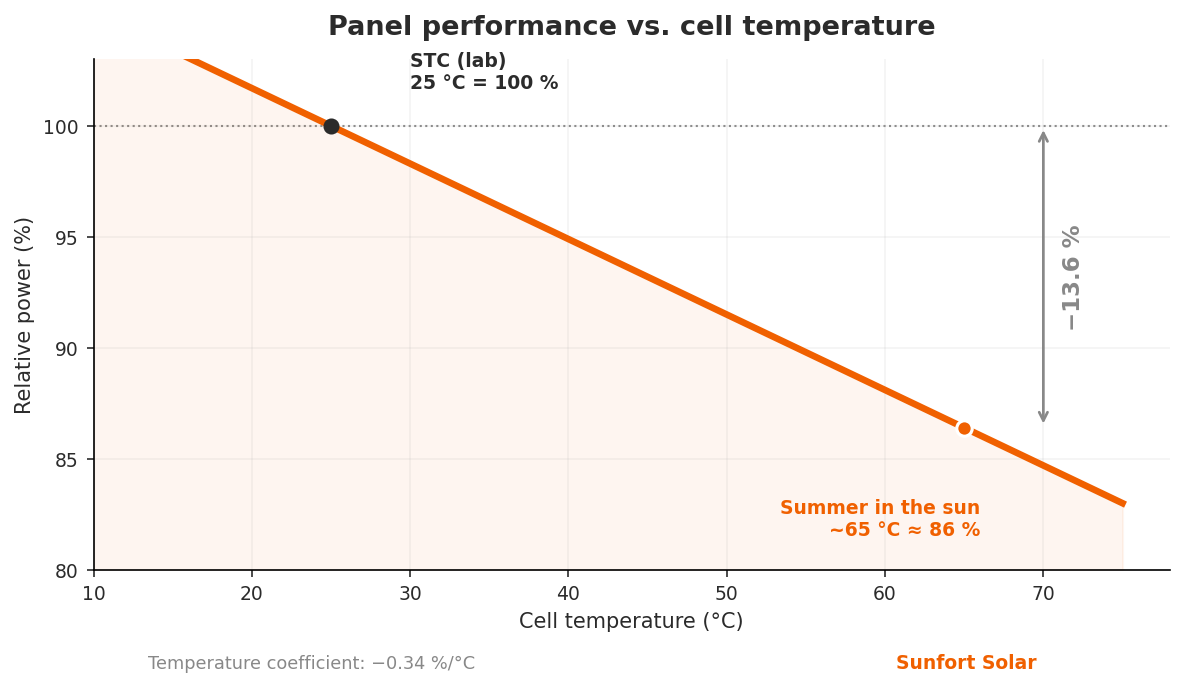
Here is the key point: on a summer day the panel’s cell is not at air temperature, but much hotter. Under direct sun, a panel can easily reach 60–70 °C cell temperature, even when the air is at 32 °C.
Let’s do the maths with a coefficient of −0.34 %/°C and a cell at 65 °C:
- Difference from the 25 °C reference: 65 − 25 = 40 °C
- Loss: 40 × 0.34 % = ≈ 13.6 % of power
In other words, that 590 Wp panel, at that moment, is delivering the equivalent of about 510 W. It is not broken: this is the normal behaviour of any panel in the world.
So is summer bad for photovoltaics?
Not necessarily. There is an important nuance here:
- Per peak hour, yes, there is a temperature loss (the derating we saw).
- Per full day, summer makes up for it with more hours of sunlight and a higher sun, so total daily production is usually good.
What surprises people is the gap between expectation and the instantaneous reading: “it’s really hot, it should be at maximum” → and it isn’t. Now you know why.
What you can do to minimise it
You can’t change physics, but you can help the panel stay cooler:
- Rear ventilation: panels should sit on a structure with an air gap, not stuck directly onto the roof. Air flowing underneath cools them and improves performance. “Flush-to-roof” installations without a gap suffer more.
- Panel choice: if you are sizing a new system in a hot climate, a panel with a low temperature coefficient (TOPCon or heterojunction) will give you more during hot hours.
- Roof and surroundings: dark surfaces that trap heat under the panels make things worse; a ventilated or light-coloured roof helps.
- Bifacial panels: they also use reflected light, gaining production without heating the front face any further.
In summary
- Light makes it produce; heat takes away.
- Every degree above 25 °C costs ~0.3–0.4 % of power.
- In summer, with the cell at 60–70 °C, you can easily lose 10–15 % of instantaneous power.
- It is not a fault: it is the normal behaviour of every panel.
- Good ventilation and the right panel choice minimise the effect.
If you notice your system producing less than it should — abnormally, not just because of the heat — or you want a new system properly sized and ventilated for our climate, at Sunfort Solar we will check it and explain it clearly. Get in touch and we’ll take a look.