Replacing radiators with water-loop units (such as Kosner KWL): what they are and when they make sense
Replacing radiators with water-loop units (such as Kosner KWL): what they are and when they make sense
If your home has water radiators, you most likely have an oil or gas boiler that pushes hot water through the pipes in winter. In summer, those same radiators do nothing for you. Many customers ask us whether they can switch to a heat pump, get cooling in summer as well and make use of their solar panels, without opening up walls or replacing the whole system.
One of the solutions that has appeared on the market is water-to-air units on a water loop. An example is the KWL range from Kosner, a heating and air-conditioning brand sold in Spain. Here we explain how the system works, what you gain, what you need to watch out for and when another option makes more sense.
The idea: take out the radiator, put in a small heat pump
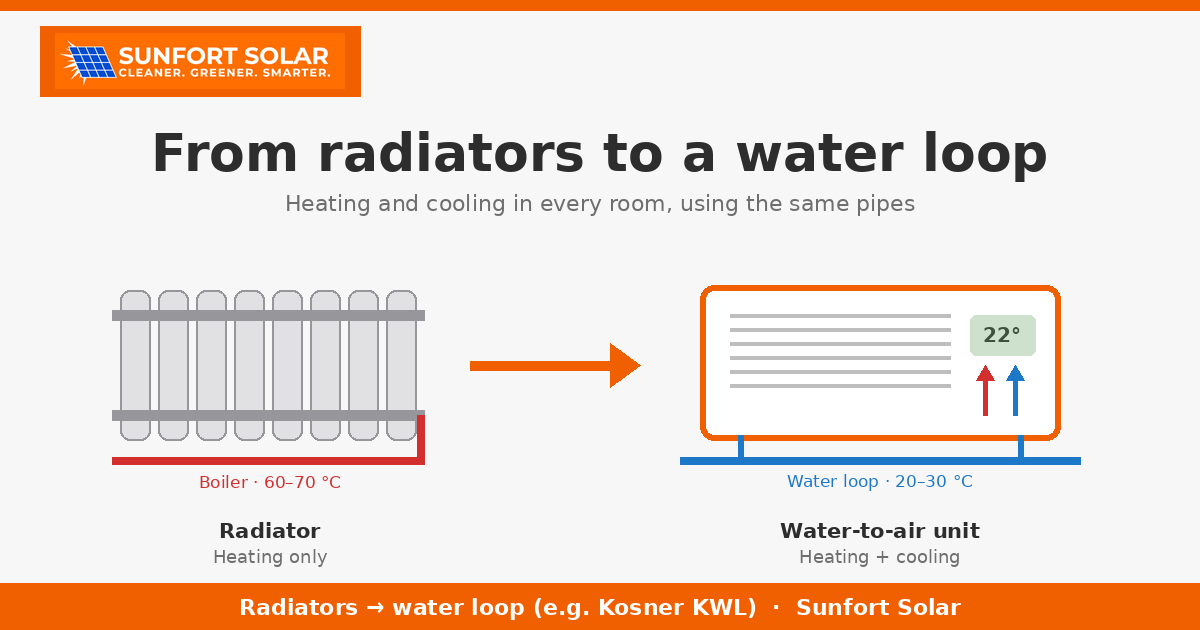
In a conventional system, the boiler heats the water to a high temperature and the radiators pass that heat into the room. If you replace the boiler with a heat pump and keep the radiators, the water still has to be fairly hot for the radiators to give off enough heat, and the hotter it has to be, the less efficient the heat pump is.
The water-loop system turns this around:
- In each room, where the radiator used to be, a unit is fitted that is actually a small water-to-air heat pump, with its own compressor and fan. It heats or cools the air in the room.
- The existing pipes form a water loop connecting all the units. What flows through it is neither hot nor cold water, but water at a neutral temperature: according to the manufacturer, between 20 and 30 °C all year round.
- A central generator, usually a heat pump, only has to keep the loop within that range.
In winter, each unit takes heat from the loop water and delivers it to the room. In summer it does the opposite: it takes heat out of the room and releases it into the loop. That is why it is sometimes called a condenser loop: the loop water acts as the shared “source” or “condenser” for all the small heat pumps in the house.
What you gain compared with radiators
- Heating and cooling from the same unit. Radiators only heat. A unit like this also cools, room by room.
- You reuse the existing pipes. This is the manufacturer’s main argument: no new channels need to be cut into the walls for water pipes. Because the loop runs at 20–30 °C, the pipes do not sweat in summer, even if they are not insulated. With a conventional chilled-water system at around 7 °C, old uninsulated pipes would drip.
- Room-by-room control. Each unit has its own thermostat and can be switched on or off separately. According to the data sheet, Wi-Fi and a presence contact are included as standard.
- No outdoor unit for each room. There is no need to hang an air-conditioning unit on the façade for every room.
- Everything is electric. If you have, or plan to install, solar panels, heating and cooling run on electricity you can produce yourself, especially in summer and during sunny hours.
What to watch out for
This system is not magic, and before deciding it is worth being clear about a few points:
- Each unit has a compressor. It makes some noise inside the room. The manufacturer’s data sheet gives a nominal sound pressure of about 33–35 dB(A), and up to 40–44 dB(A) at maximum, depending on the model. In a bedroom, choose the model and position carefully.
- Each unit needs a power supply. Radiators need no electricity; these units do (230 V single-phase). Depending on where they are, a cable may have to be run.
- Condensate drainage. When cooling, they condense water from the room air, like any air conditioner. The data sheet says a condensate pump is built in, but the water still has to go somewhere.
- Weight and size. They are bulkier than a slim radiator: about 14 cm deep, about 64 cm high and 78 to 123 cm long, weighing 35 to 45 kg empty, depending on the model. The wall has to carry that.
- Check the pipes and the circulation pump. Being able to reuse the pipes does not mean they will always work as they are. Diameters, flow rates, condition and leaks must be checked before quoting.
- You still need a central generator. The loop has to be kept between 20 and 30 °C, and that is done by another piece of equipment. The real efficiency of the whole system depends on both: the room units and the generator.
- It is a new product. The KWL range is listed in Kosner’s catalogue as new for 2025. There is still little practical experience in homes, and the published efficiency figures are the manufacturer’s.
When it makes sense and when it does not
It makes sense mainly when:
- The house already has radiators and water pipes in good condition, and you want to avoid building work for ducts or new pipes.
- You want heating and cooling in several rooms, with individual control.
- The oil or gas boiler needs replacing anyway, and you want to move to an electric system that can be combined with solar panels.
There may be simpler options when:
- You only need heating and the radiators work well. Often an air-to-water heat pump feeding the existing radiators is enough, checking whether some radiators need to be enlarged so the house stays warm with lower water temperatures.
- You only want cooling in two or three rooms. A split air conditioner is usually more straightforward.
- You are doing a full renovation. Then other systems, such as underfloor heating or ducted units, are worth considering.
What about the price?
Kosner does not publish prices for this range: the data sheet refers you to the sales team. On top of that, the final cost depends heavily on the house: how many units are needed, the state of the pipes, which central generator is used and what electrical work is required. That is why we prefer not to give ballpark figures without seeing the installation.
Our recommendation
If you have radiators and want to get rid of the boiler, the first step is not choosing the unit but looking at the house: how many rooms, how much heat each one needs, the condition of the pipes and whether you also want cooling. With that, you can compare in figures a heat pump with your existing radiators, a water-loop system such as KWL, or an air-conditioning solution.
At Sunfort Solar we can help you make that comparison in the Alt Empordà, and combine it with solar panels so your heating and cooling run on your own sunshine as much as possible. Contact us and send us a few photos of your radiators and boiler.
The technical data in this article come from the manufacturer’s data sheet (Kosner, “Autónomo agua/aire KWL”, new for 2025). They may change; before any installation they are checked against the current documentation.