The RCD trips and the solar panels stop producing: automatic reclosing
The RCD trips and the solar panels stop producing: automatic reclosing
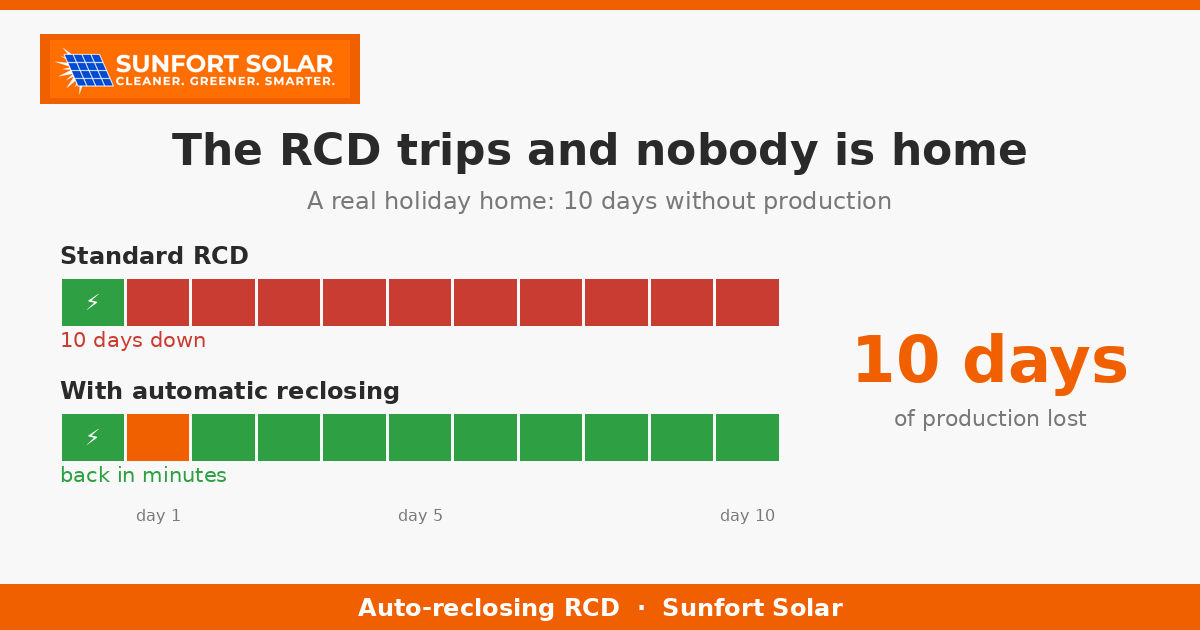
One of our customers in the Alt Empordà wrote to us, worried: his installation had not produced anything for days. When we went there, the cause was very simple: the RCD (residual-current device) on the grid side of the inverter had tripped. We switched it back on and everything worked again instantly. But the house is a second home, nobody was there to notice, and the installation sat idle for ten days.
This is far more common than it seems, especially on the coast, where many houses stand empty for weeks. Today we explain why an RCD trips in an installation that was working fine, and how to stop something so small from costing you days of production.
What an RCD does
The RCD (residual-current device, called “interruptor diferencial” in Spain) compares the current flowing into a circuit with the current flowing out. If they differ, part of the current is escaping somewhere, for example to earth through a person. When the difference exceeds its sensitivity (in homes, normally 30 mA), it cuts the circuit within milliseconds.
It is the protection that saves lives, and the regulations (the REBT, Spanish low-voltage regulations) require it. That is why it must never be removed or bypassed.
Why does it trip if it was fine until now?
An RCD tripping does not necessarily mean there is a serious fault. The most common causes in a photovoltaic installation are:
- Moisture. After rain or in very humid air, small leaks in junction boxes, connectors or outdoor cables can add up to enough current to trip it.
- Voltage spikes on the grid. A storm or a switching operation by the grid operator can cause a transient that the RCD reads as a leak.
- Accumulated leakage. Inverters, like many other electronic devices, have small normal leakage currents. If other circuits share the same RCD, the total can sit close to the limit and trip at the slightest thing.
In all of these cases, the RCD is doing its job. The problem is what comes next: it stays off until someone switches it back on by hand. If nobody is at home, the installation can go for weeks without producing.
The solution: an RCD with automatic reclosing
An RCD with automatic reclosing (auto-reclose) is a normal RCD with a small motor that, after a trip, switches itself back on. Good devices don’t do this blindly:
- They wait a few seconds or minutes before reconnecting.
- Many check the insulation of the circuit before reclosing. If the leak is still there, they don’t reclose.
- They make a limited number of attempts. If it trips several times in a row, it stays off, because then there really is a fault that needs to be inspected.
In other words: they recover on their own from one-off trips (a night’s moisture, a voltage spike) and keep protecting when there is a real problem. These devices are covered by the UNE-EN 50557 standard (EN 50557), and it is important that the model is compatible with the RCD and with the installation.
Where it makes the most sense
- Second homes and houses that stand empty for long periods.
- Installations with a battery, where a trip can leave the house without backup supply.
- Critical circuits: fridges, pool pumps, alarms, cameras.
- Areas with frequent storms or high humidity, such as the coast.
It does not replace maintenance
Automatic reclosing solves one-off trips, but not leaks that keep growing. That is why, when we fit one, we also measure the insulation of the installation: if a cable or connector starts to degrade, it is better to find it before the RCD trips every week.
And above all: you need to know the installation has stopped. An app nobody looks at warns nobody. What you need is monitoring that alerts you when the plant stops producing in the middle of the day, so you find out the same day and not ten days later.
In short
- An RCD tripping now and then is normal: moisture and voltage spikes are the most common causes.
- The problem is not the trip, but that nobody switches it back on.
- An RCD with automatic reclosing switches itself back on and keeps protecting if there is a real fault.
- Combined with an insulation check and good monitoring, it prevents lost days of production.
Do you have a second home with solar panels, or has your RCD already tripped once? Tell us and we’ll let you know whether an RCD with automatic reclosing makes sense for you.