My PV inverter keeps shutting off: why it happens and what you can do
My PV inverter keeps shutting off: why it happens and what you can do
You have a PV installation and notice that the inverter shuts off by itself during the day, especially during peak production hours. It usually recovers after a while, only to do it again the next day. If you have access to the manufacturer’s app (Fronius Solar.web, DEYE Cloud, Hoymiles S-Miles, etc.) and see error codes like OV-G, Vac > 253V, Grid Overvoltage, AC Voltage Out of Range, or equivalents, the inverter isn’t broken: it’s doing its job.
In this article we explain what’s happening, why it’s not your fault and not your installer’s, and what the correct route is to fix it.
What’s happening: the 253 V limit
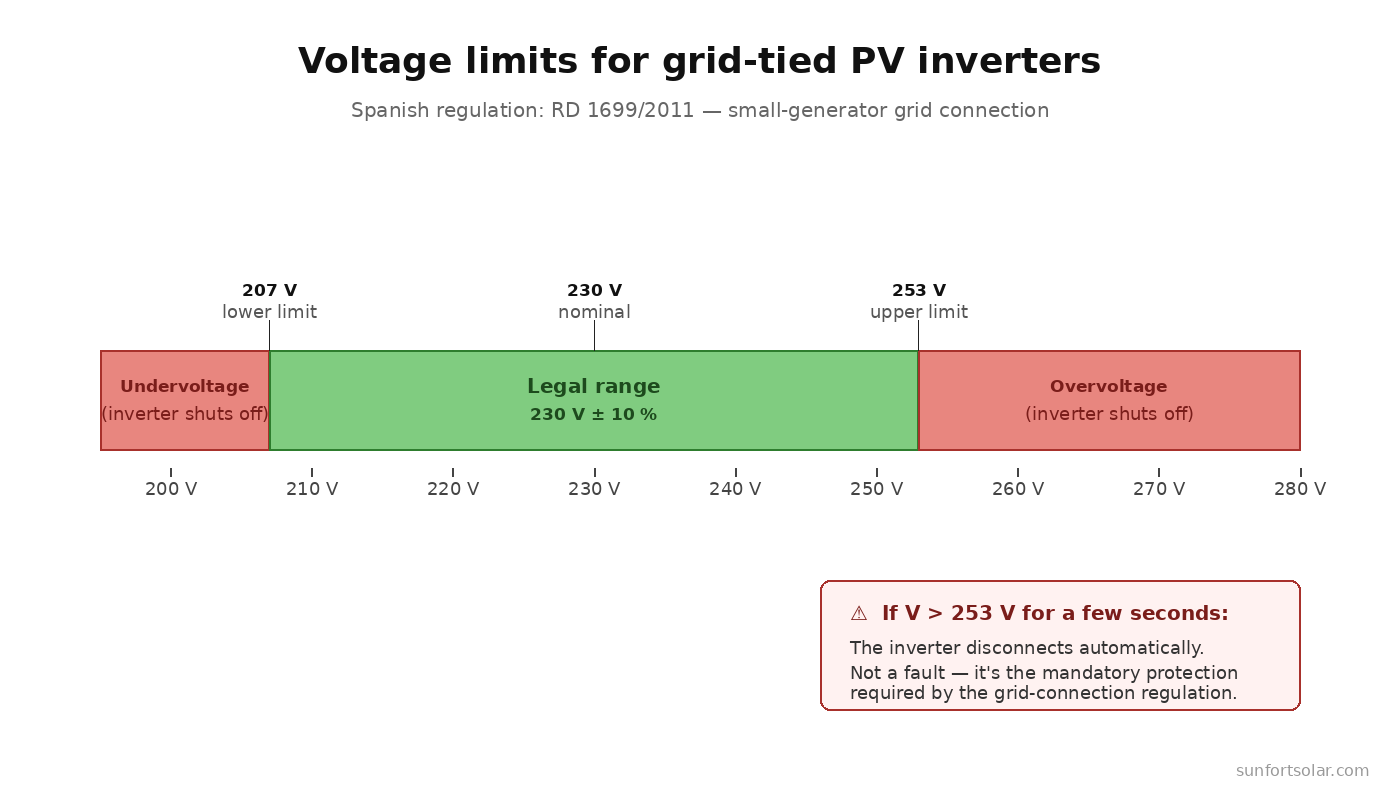
Grid-tied PV inverters are required to disconnect when the mains voltage exits a strict band. In Spain, those limits are set by Royal Decree 1699/2011, which regulates how small generators connect to the public electricity grid.
The relevant numbers for a single-phase inverter:
- Nominal grid voltage: 230 V (phase-to-neutral).
- Legal margin: ±10 %, i.e. between 207 V and 253 V.
- If the AC voltage measured at the inverter output exceeds 253 V for more than a few seconds, the inverter disconnects automatically as a safety protection.
This isn’t arbitrary. If every inverter in a neighbourhood pushes power into a grid that’s already at the upper edge of the band, the combined effect can push the voltage even higher and damage household appliances, LED lighting, sensitive electronics, even the inverters themselves. So the regulation forces the disconnection before that happens.
Why does the grid have overvoltage?
The most common cause isn’t inside your house: it’s at the neighbourhood transformer.
Distribution transformers feeding residential streets are tapped with some margin to compensate for line losses. In sparsely populated areas — especially the coast or holiday-home developments where demand is very low off-season — the voltage can be too high at baseline: 240 V, 245 V or more, even before you start injecting any energy.
When you (or a neighbour with a recent install) inject self-consumption power around midday, the voltage at your pole goes up even more — and approaches the 253 V limit. Peak sun hours (12:00–15:00 in summer) is when most disconnections happen.
Factors that make the problem more likely:
- Distance from the transformer: the further you are, the more line drop in normal conditions, but also the more “rebound” effect when someone injects near the line end.
- Low user density: holiday-home areas, sparse developments (typical for the Empordà and the Costa Brava).
- Line shared with many other self-consumption installs: cumulative effect.
- Old transformer without an automatic load-tap-changer (LTC).
How do I know it’s grid overvoltage and not an actual fault?
Several signs point to grid overvoltage rather than equipment failure:
- It happens during the brightest hours (not at dawn, not at night).
- It recovers on its own after a few minutes, no intervention needed.
- Error codes mention “voltage” or “grid”:
OV-G01,OV-G02,Vac too high,Grid Voltage Fault, etc. - If you have access to the detailed logs, you’ll see AC voltage readings above 253 V just before each disconnection.
- Your neighbours suffer it too: their inverters trip at similar times, or they’ve replaced LED bulbs more often than usual (chronic overvoltage degrades them).
What you can do as the owner
Step 1 — Confirm the cause with data
Ask your installer (or check the manufacturer’s app yourself) to pull the AC voltage readings for the past few days, especially around the disconnection moments. If you see consistent peaks above 253 V, you’ve got the objective evidence.
Step 2 — File a formal complaint with the distribution operator
In Catalonia, most areas are served by e-distribución (Endesa’s distribution brand). The proper procedure:
- Web: edistribucion.com → Reclamaciones section → Calidad de suministro.
- Phone: 800 760 333 (free).
Your complaint should include:
- Supply number (CUPS).
- Exact address.
- Problem description: “My PV inverter is repeatedly disconnecting due to grid overvoltage (>253 V), the limit set by RD 1699/2011.”
- Dates, times, and voltage readings supporting it.
- Explicit request: line inspection and adjustment of the local transformer tap.
Step 3 — What to expect from the operator
If the complaint is well documented, e-distribución (or your operator) is required by supply-quality regulation to send a technician within a specific time frame (typically 30–45 days). The fix is often as simple as changing the tap on the neighbourhood transformer (essentially lowering the output voltage) or, in chronic cases, installing an automatic regulator.
It’s a free intervention for the consumer — keeping the grid voltage within legal limits is the operator’s responsibility.
What a professional installer can do while the operator reacts
While waiting for the official resolution — and always within the regulatory framework — a qualified installer can:
- Widen the inverter’s protection threshold within the manufacturer’s allowed range (some models accept Vac thresholds between 253 V and 264 V during transients per RD 244/2019). This reduces disconnections but doesn’t address the root cause.
- Verify the AC wiring: an undersized AC cable run increases internal voltage drop and, paradoxically, raises the voltage measured by the inverter itself.
- Activate Volt/VAR or reactive support functions on the inverter (when supported), which help stabilise the local grid.
All of this requires the manufacturer’s installer password (Fronius, DEYE, Hoymiles, Huawei, etc.) and regulatory knowledge — touching protection parameters without that background can void the warranty and, in case of an incident, expose the operator to liability.
Recent real case
This very week we visited a client in Empuriabrava with a Fronius inverter that disconnected every midday. The display kept showing Vac > 253 V, and the client was worried about a hardware failure. A quick multimeter reading and a glance at the logs confirmed that the street voltage was running between 252 V and 256 V during sun hours — clearly out of range.
We’ve drafted the complaint to e-distribución with the actual data and are now waiting for the inspection. The client’s inverter works perfectly: it’s the grid that needs to be brought back into spec.
Conclusion
If your PV inverter disconnects repeatedly and you see grid-voltage error codes (OV-G, Vac, Grid Overvoltage):
- It’s not an equipment failure. The inverter is protecting itself and your installation.
- The most likely cause is mains voltage too high in your neighbourhood.
- Bringing the grid back into spec is the operator’s responsibility, not yours or your installer’s.
- The right path is a formal supply-quality complaint to e-distribución (or your operator), with objective data.
- Meanwhile, a professional installer can make adjustments within regulation to minimise disconnections, but the real fix has to come from the operator.
At Sunfort Solar we run into this scenario regularly with clients in the Alt Empordà and the Costa Brava: areas with lots of second homes where self-consumption is growing faster than grid modernisation. If you have doubts about your inverter’s behaviour or want help documenting and filing the complaint, get in touch and we’ll take a look.
Want us to review your case?
If your inverter shuts off frequently and you suspect grid overvoltage, fill in the form and we’ll get back to you for a first analysis (no commitment). If we confirm the issue, we’ll help you prepare the formal complaint to the distribution operator.
📞 Prefer to call? +34 872 580 022 📧 Or email us: info@sunfortsolar.com
This article is part of our commitment to making PV maintenance more transparent. If you found it useful, share it with someone who also has a solar installation.