Pool heat pump: what power, which cable and which protection you need
Pool heat pump: what power, which cable and which protection you need
This week we prepared the electrical certificate for a house with a pool in the Alt Empordà. The owner wanted to add a heat pump to make the swimming season longer, and the question was the usual one: “The machine says 20 kW. Does that mean I need 20 kW of electricity?” The answer is no, but the power, the cable and the protection devices need to be checked properly before it is connected.
Here is what to keep in mind so that a pool heat pump runs safely and is correctly declared on your electrical certificate.
Heat output and electrical power are not the same thing
The big number in the brochure (15, 20, 25 kW…) is the heat output: the heat the machine can deliver to the pool water. A heat pump does not make that heat directly from electricity. It takes it from the outside air and “pumps” it into the water. That is why every kW of electricity gives you several kW of heat.
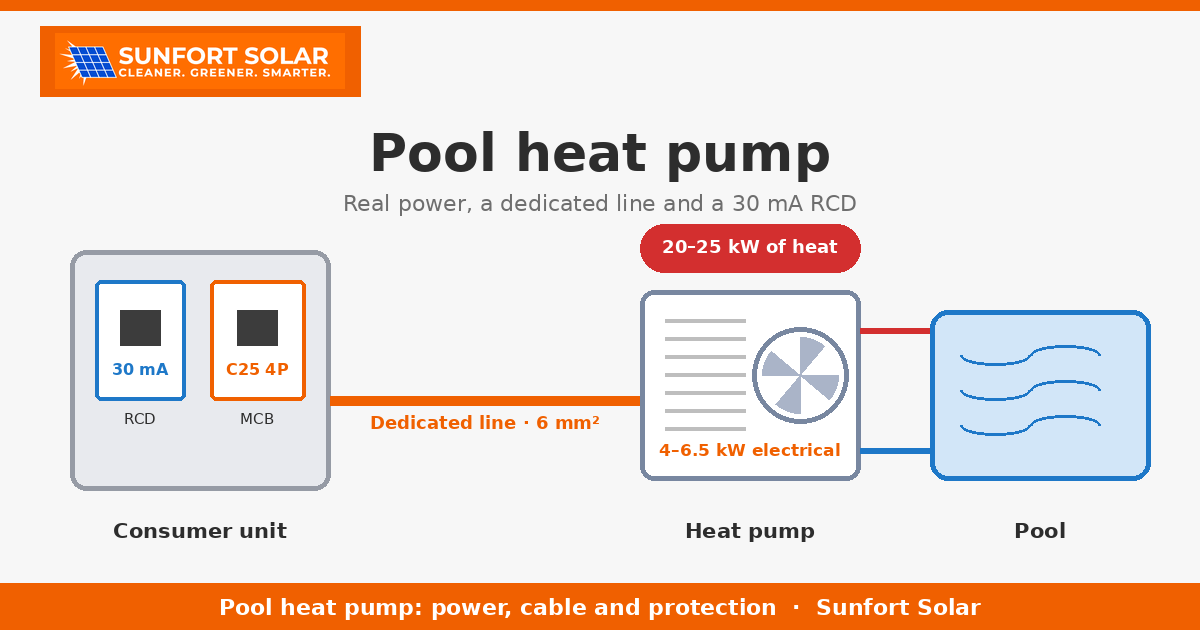
In practice, a pool heat pump rated at 20–25 kW of heat uses about 4–6.5 kW of electricity when running flat out. The exact figure depends on the machine and the weather: with warm air it works more efficiently, while in spring or autumn, with cooler air, it is less efficient and gets closer to its maximum consumption.
To size the electrical installation, the heat output is not what matters. What matters is the maximum electrical input and the maximum current stated by the manufacturer on the data sheet or the rating plate. That is the number your line, your consumer unit and your contracted power have to cope with.
A dedicated line, with the right cable and circuit breaker
A machine that can draw 6 kW for hours should not be plugged into a socket or hung off a line that already feeds other things. It needs its own dedicated line from the consumer unit, with three parts that have to match:
- The cable, sized for the current it will carry and for the length of the run. If the heat pump is far from the consumer unit, a thicker cable may be needed so the voltage does not drop too much.
- The circuit breaker (MCB), which protects that cable against overloads and short circuits.
- The RCD, which protects people (more on that below).
The key rule is simple: the circuit breaker has to suit the cable, not just the machine. If the breaker is too big for a cable that is too thin, the cable can overheat beyond its limit without the breaker ever tripping. It is a fire risk you cannot see until it happens.
A real example from this week: a three-phase heat pump drawing about 6.4 kW, fed with 6 mm² cable and protected by a three-phase C25 circuit breaker. The combination is consistent: the 25 A breaker gives the machine some headroom, and a 6 mm² cable, in a typical installation, carries those 25 A with room to spare. The cable sizes and their permitted currents are set by the Spanish Low Voltage Electrical Regulations (REBT), in instruction ITC-BT-19, and they depend on how the cable is installed (buried, in conduit, in open air…).
One more point: if the heat pump is three-phase, the house needs a three-phase supply. And whether it is single-phase or three-phase, check that your contracted power covers the heat pump plus the rest of the house, especially if you also have an electric car, a heat pump for the house or an electric oven.
At the pool, a 30 mA RCD is mandatory
Water, wet bodies and electricity: that is why swimming pools have their own instruction in the REBT, ITC-BT-31, which is stricter than the rules for an ordinary home installation. Among other things:
- It defines zones around the pool (in the water, the edge and a strip beyond it), and in each one it limits which equipment is allowed, at what voltage and with what degree of protection against water.
- It requires the circuits feeding the pool equipment to be protected by a high-sensitivity 30 mA RCD, which cuts the power if it detects even a very small leakage current.
- It calls for equipotential bonding: connecting the surrounding metal parts (ladders, handrails, reinforcement…) to earth so that no dangerous voltage differences can appear.
The heat pump, the pool pump and the pool lighting are all part of this. A practical tip: check the heat pump’s manual, because some inverter units require a specific type of RCD. And another: do not share the pool’s RCD with half the house. If it trips, it is much better if only the pool stops.
What the electrical certificate (CIE) looks at
When an installation is extended, the electrician has to issue the Electrical Installation Certificate (CIE, known locally as the butlletí or boletín). Among other things, it declares the real installed power of each part of the installation, including the pool: pool pump, heat pump, lighting and any other equipment.
Declaring this power correctly matters for two reasons:
- The installation has to be designed for the real power. The cables, protection devices and voltage drop shown on the certificate must match what is actually connected.
- The paperwork depends on the power. For pools, the regulations set thresholds: if the installed power of the pool exceeds 10 kW, the type of procedure can change, with more technical documentation or an inspection by an approved inspection body before it can be switched on. If the heat output is added up instead of the electrical power, or extra is added “just in case”, it is easy to cross the threshold for no reason and turn a simple procedure into a complicated one. And the other way round: declaring less than the real figure to make it fit protects nobody.
In this week’s case, the real total for the pool (pool pump, heat pump and the rest) was about 9 kW, and that is what was declared.
Before you buy the heat pump, have an electrician look at your consumer unit
The time to ask these questions is before you buy the machine, not once it is sitting in the garden. In a short visit, an electrician can tell you:
- whether you have a single-phase or three-phase supply, and whether the machine you like will fit;
- whether your contracted power is enough or needs to be increased;
- where the new line will run, how long it will be and which cable it needs;
- whether your consumer unit has room for the new breaker and RCD, or a separate pool panel is needed;
- how the total pool power will appear on the certificate.
With those answers you can choose your heat pump with peace of mind, knowing what will need to change in your installation.
At Sunfort Solar we carry out electrical installations and certificates in the Alt Empordà, and we often combine the pool heat pump with solar panels, so the midday sun heats the water. Get in touch and send us a photo of your consumer unit and the data sheet of the heat pump you are looking at: we will tell you what is needed before you buy it.