Pigeons under your solar panels: how to stop them (mesh, wires and bird scarers)
Pigeons under your solar panels: how to stop them (mesh, wires and bird scarers)
This week we were on a roof in Empuriabrava where pigeons had moved in under the solar panels. From the street you could not see a thing. But underneath there were nests, feathers and a thick layer of droppings, and the sound of feet on the roof started very early in the morning.
It is not an unusual case: on the coast, where pigeons are around all year, it is one of the questions we hear most often. Today we explain why it happens, what damage it does and how we solve it.
Why pigeons go under the panels
For a pigeon, the gap between the panels and the roof is an ideal spot:
- Shade in summer and shelter in winter. The panels act as a roof: no rain, no sun and no tramontana wind.
- Protection from predators. Gulls and birds of prey cannot get in.
- A place to nest. Once a pair has bred there, they come back, and more follow.
The lower the mounting structure and the flatter the roof, the easier we make it for them. On flat roofs with tilted frames, the space underneath is large and open at the sides.
What damage they do
It is not just about dirt:
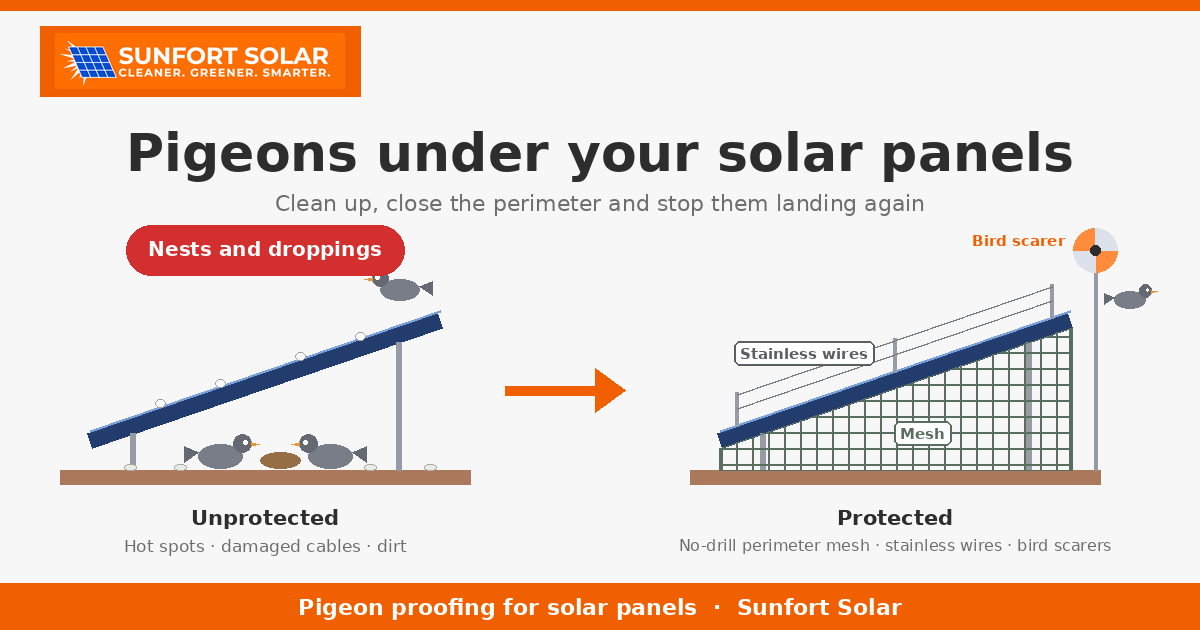
- Droppings on top of the panels. A dropping on a cell shades it: that cell stops producing and heats up. This is what we call a hot spot. In the long run it can damage the panel, and in the meantime output drops.
- Droppings underneath. They build up on the roof, the frame and the gutters, block drains and are acidic: over time they attack materials and seals.
- Cables and connectors. Pigeons peck, and nesting material (twigs, feathers, bits of plastic) piles up exactly where the cables and connectors run. We have seen damaged cable insulation and nests covering connectors. That is dry material right next to an electrical installation, and it should not be there.
- Hygiene. Dry droppings and feathers can carry disease. That is why cleaning takes more than a broom.
- Noise and smell in houses where the roof is close to bedrooms or a terrace.
The solution we use
The order matters. If you close the gap first and clean later, or close it with a nest still inside, the problem continues.
1. Clean and sanitise under the panels
First, nests, feathers and droppings are removed from under the panels and from the roof, and then the area is disinfected. We work with gloves and a mask, taking care not to raise dust. We take the opportunity to check cables, connectors and the frame, and to clean the top of the panels if they are dirty.
If there is a nest with eggs or chicks, you need to wait or act with judgement. And if they are not pigeons but swallows or swifts, it is a different matter: they are protected species and their nests must not be touched.
2. Perimeter mesh with clips, no drilling
Once it is clean, the gap between the panels and the roof is closed with a metal mesh around the whole perimeter of the array. We use galvanised steel mesh with a PVC coating, which lasts for years outdoors and near the sea.
The mesh is fixed to the panel frames with special clips that drill nothing: not the panel, not the frame, not the roof. That way the panel warranty and the roof’s waterproofing are left untouched. Air still flows through, so the panels keep cooling from below, and if one day someone needs to reach a connector, a section can be taken off and put back.
3. Stainless wires above the panels
The mesh keeps them from getting underneath, but pigeons still land on the top edges of the panels, and that is where they make a mess. To prevent this, stainless steel wires are tensioned on small supports a few centimetres above the edge. The pigeon finds nowhere stable to land and goes elsewhere. Some people prefer nylon line because it is less visible, but it degrades in the sun and breaks sooner. Stainless steel lasts many more years.
4. Reflective bird scarers
As an extra, we fit reflective bird scarers, pieces that turn in the wind and throw flashes of light. They do not solve the problem on their own, but they make the roof a less peaceful place for birds, especially in the first days, when the pigeons try to return to where they used to breed.
Safety first
Working on a roof with panels means working at height. Our rules are simple:
- Always in a harness, clipped to an anchor point or a lifeline.
- Never a platform or a walkway on a fragile roof. Fibre-cement roofs, translucent sheets and some lightweight roofs cannot take a person’s weight. If the roof is not safe, the work is done from outside, with a mobile elevating platform or whatever is needed.
- Never step on the panels.
That is why we do not recommend doing it yourself: the biggest risk is not the pigeons, it is the fall.
When to do it
On the coast, pigeons breed almost all year round, but mostly in spring and summer. The best time is before the nesting season starts, at the end of winter. If it is done when there are already nests with chicks, you have to wait or take more care.
And if you are about to install panels in an area with pigeons, fitting the mesh on installation day costs less than coming back later to clean up.
What the cost depends on
There is no fixed price, but the quote depends mainly on:
- The metres of perimeter to close off, that is, how many rows of panels there are and how they are laid out.
- Access and roof height, and whether a lifting platform is needed.
- The type of roof: flat, tiled or fragile.
- How much dirt there is and whether the panels need cleaning too.
- Whether wires and scarers are added on top of the mesh.
Our recommendation
If you hear pigeons on the roof or see droppings on the panels, do not wait for more of them to arrive. The longer they stay, the more dirt, the more risk to the cables and the more cleaning work.
At Sunfort Solar we clean and pigeon-proof solar systems in the Alt Empordà, both our own installations and other installers’. Get in touch and send us a couple of photos of the roof and of the space under the panels.