How to tell if a panel or microinverter in your system is underperforming
How to tell if a panel or microinverter in your system is underperforming
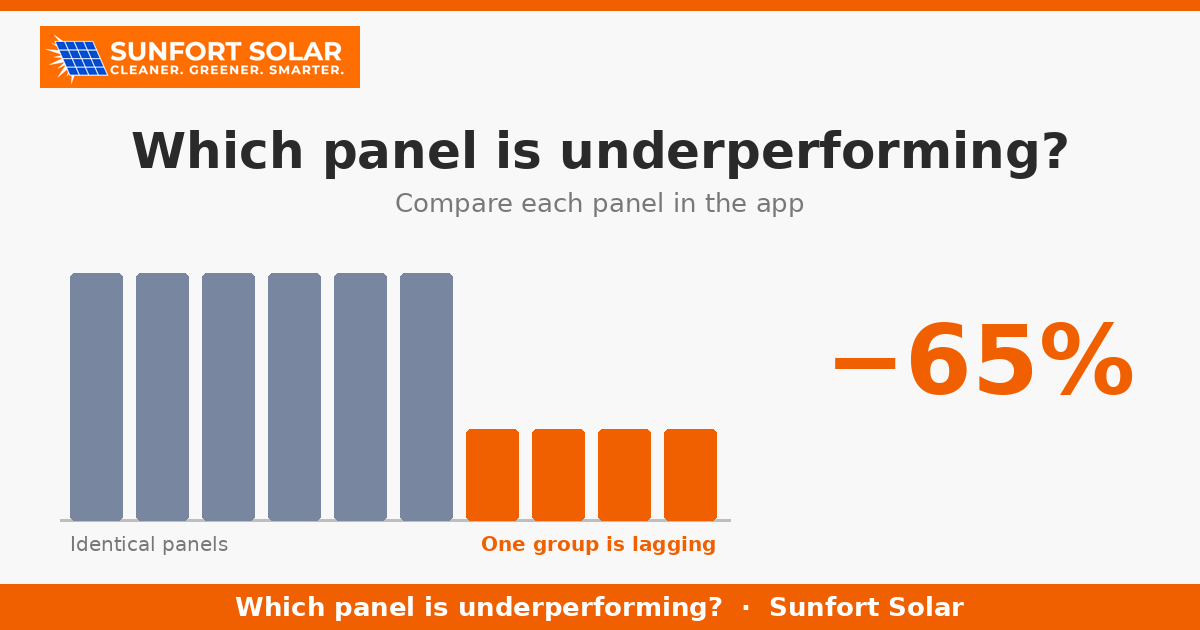
One of our customers asked us a simple question: “Can I fit better optimizers? I feel like the panels could give more.” Before recommending anything, we looked at the data from his system. The surprise was that the problem wasn’t the whole installation: one of the two microinverters was producing only a third of what it should, while the other worked perfectly. For months, half of the panels had been working far below their potential, and from the outside you couldn’t tell.
Today we explain how you can check yourself whether a panel or a microinverter is underperforming, what the most common causes are, and when it is worth sending a technician.
Why we don’t notice
An installation that underperforms makes no noise and raises no alarm: it simply produces less. If your electricity bill is still low, or if the summer was good, it is easy to think everything is fine. On top of that, output varies a lot from one day to the next because of clouds, and a 20 or 30% loss is easily hidden among good and bad days.
The key is to compare, not to look at the total figure.
The method: compare identical panels at the same moment
If you have microinverters (Hoymiles, APsystems, Enphase…) or optimizers, the app shows you the output of each panel. It is the most useful tool you have:
- Open the per-panel view at full sun, around midday.
- Group the panels by orientation. Panels facing the same direction at the same tilt should produce almost the same: normal differences are 5–10%.
- Look for the one that stands out. If one panel, or a whole group connected to the same microinverter, clearly produces less (30, 50 or 70% less), something is wrong.
- Repeat it on another day and at another time. If the difference only shows up early in the morning or in the afternoon, it is almost certainly shade. If it is there all day, it is another problem.
If you have a string inverter (a single inverter for all the panels), you won’t see each panel separately, but you can compare each month’s production with the same month last year, or with a neighbour who has a similar system.
The most common causes
New shade. A tree that has grown, an antenna, a chimney or building work next door. Partial shade on a single panel can drag output down far more than you’d expect.
Accumulated dirt. Dust, leaves and, above all, bird droppings. Near the sea and in areas with little rain, a cleaning can recover a noticeable part of the output.
Connections. A solar connector that is badly seated or oxidised, or a damaged cable (rodents are fond of them), wastes energy or takes the panel out of service altogether.
A failing microinverter or input. Microinverters have several inputs, and only one may fail. That is what happened in our customer’s case: the problem was concentrated in one of the two units.
A faulty panel. Less common, but it happens: damaged cells, hot spots or premature degradation. A thermal camera finds it quickly.
What you can do and what a technician should do
You can, without going up on the roof:
- compare the panels in the app, as we have explained;
- check whether there is new shade at different times of the day;
- look, from a safe place, whether the panels are visibly dirty.
What a technician should do, for safety (a solar installation carries DC voltage even with the main switch off):
- measure the voltage and current of each panel;
- check the connectors and the wiring;
- test the microinverter and, if needed, process the warranty claim. Microinverters usually come with long manufacturer warranties, and a faulty unit is often replaced at no cost for the equipment.
The bottom line
A solar installation doesn’t warn you when it underperforms. Spending five minutes now and then comparing identical panels in the app lets you catch in time problems that could otherwise cost months of production. If you see a difference you can’t explain, send us a screenshot of the app: often, with the data, we can already tell where the problem is before we go there.
At Sunfort Solar we inspect and maintain photovoltaic installations in the Alt Empordà, whether we installed them or not. Contact us and we’ll take a look together.