EV charger at a holiday rental: how to make the guest pay for the electricity
EV charger at a holiday rental: how to make the guest pay for the electricity
If you own a holiday rental in Empuriabrava, Roses or Castelló d’Empúries, you have probably been asked already: “Is there somewhere to charge the car?” Many guests arrive from France, Germany, Belgium or the Netherlands in an electric car, and after 1,000 km on the road the first thing they want is a safe socket right outside the door.
Installing a charger is relatively straightforward. The important question is a different one: who pays for the electricity? Today we explain the options, the technical points to keep in mind, and how it all fits together if you already have solar panels.
Why guests ask for it
On booking platforms, “EV charger” is a filter many travellers switch on. If your house doesn’t have one, it simply doesn’t show up in the search. For anyone travelling in an electric car, charging overnight at the house is far more convenient than hunting for a public charger, often busy or expensive, in the middle of August.
It won’t rent the house out on its own, but it is one of those details that tip a booking and that guests remember in their reviews.
The problem: who pays for the electricity
A full charge can be anywhere from 40 to 80 kWh. If a guest charges every day for a week, your bill will show it. There are four ways to handle it:
1. Included in the rent. The simplest option and the one guests like best, but the risk is yours: you don’t know whether you’ll get a guest who never charges or one who charges two cars every night. It only makes sense if you raise the nightly rate accordingly.
2. A flat fee per stay. For example, a set amount per week if the guest wants to use the charger. It is easy to explain and to collect together with the cleaning fee, but it is still an approximation: some guests come out ahead, others don’t.
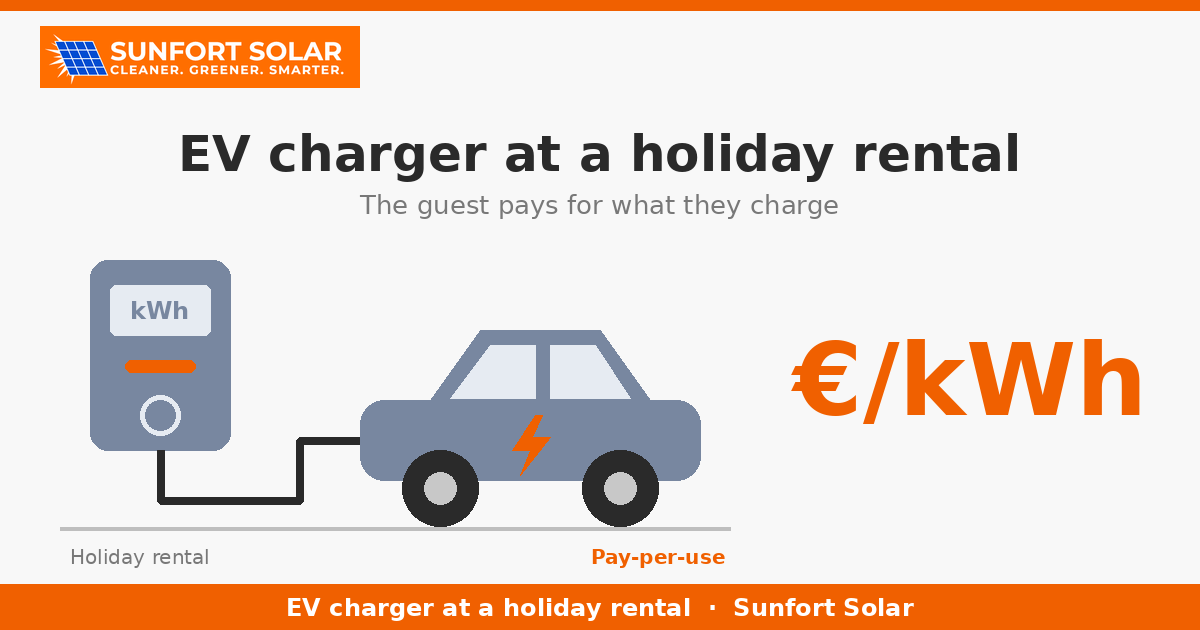
3. Pay-per-use, with an RFID card or an app. The fairest option. A smart charger that supports OCPP (the standard protocol for chargers) connects to a management platform where you set the price per kWh. The guest identifies with a card you leave at the house or with an app, charges, and the platform bills them for what they used. You get the details of every session and don’t have to do any sums. These platforms usually charge a subscription or a commission, so it is worth comparing them before you choose.
4. A separate meter. A meter dedicated to the charger tells you exactly how many kWh were used during each stay, and you can charge for it at check-out. It works, but someone has to read the meter at every changeover.
For most holiday rentals, option 3 is the one that means the least work in the long run.
The technical points to check
Contracted power. This is the most important point. If the house has 5.75 kW contracted and the guest starts charging while the air conditioning, the pool pump and the oven are running, the main breaker trips and the house goes dark. The solution is dynamic load management: a sensor in the electrical panel measures the household consumption and the charger automatically reduces its power when needed. That way you don’t need to increase your contracted power, or you need to increase it less.
Single-phase or three-phase. On a single-phase supply, a home charger reaches about 7.4 kW; on three-phase, 11 kW. For a guest charging overnight, 7.4 kW is more than enough: it fills most batteries in one night.
Distance and cable. The further the parking space is from the electrical panel, the thicker the cable needs to be so it doesn’t overheat or lose voltage. If trenches need digging or the cable has to cross the garden, that weighs more on the quote than the charger itself.
Outdoors. If the charger is mounted outside, it needs a suitable protection rating (IP54 or higher) and must be protected against knocks. Near the sea, salt in the air matters too.
Protection devices. The charger circuit needs its own circuit breaker and an RCD suitable for electric vehicles: type A with DC fault detection (many chargers already have it built in) or type B.
If you already have solar panels
Here’s the good news. Many smart chargers can charge primarily from solar surplus: during the day, the energy your panels produce and the house doesn’t use goes into the car instead of being exported to the grid at a low price. Nothing changes for the guest, but your cost per kWh drops, and the margin between what you charge and what it costs you improves. The charger and the inverter need to be able to talk to each other, which we have to check case by case.
Paperwork and regulations
In Catalonia, as in the rest of Spain, the charger must be installed by an authorised electrical installer, in compliance with technical instruction ITC-BT-52 of the low-voltage regulations. When the work is done, the installer issues the installation certificate (the “butlletí”), which is the document your insurer will ask for if there is ever a problem.
As for subsidies, the MOVES III programme has funded chargers in recent years. The conditions and deadlines change frequently, so ask us about the current status when you’re ready to install.
Quick checklist for owners
- What power do you have contracted, and what large appliances does the house have (air conditioning, pool, heat pump)?
- Is the supply single-phase or three-phase?
- How far is the parking space from the electrical panel?
- How do you want to charge for electricity: included, flat fee or pay-per-use?
- Does the charger support OCPP and dynamic load management?
- Do you have solar panels, or are you considering them?
If you own a holiday rental in the Alt Empordà and want to offer charging to your guests without paying for the electricity yourself, message us on WhatsApp or via the chat on our website and we’ll tell you which solution fits your house.