Electrical Installation Certificate (CIE): When It’s Mandatory and How to Obtain It
Electrical Installation Certificate (CIE): When It’s Mandatory and How to Obtain It
Do you want to install solar panels or increase your home’s contracted power capacity? Before doing so, you’ll probably need a Low Voltage Electrical Installation Certificate (CIE). This document is legally mandatory in many cases, but few people know about its existence until the electricity company requests it.
In this article we explain what the CIE is, when it’s mandatory to obtain it, how the process works and why it’s so important for your home’s safety.
What is the Low Voltage CIE?
The Electrical Installation Certificate (CIE) is an official document that certifies that the electrical installation of a home, premises or building complies with current electrical safety regulations.
It is based on the Low Voltage Electrotechnical Regulations (REBT), approved by Royal Decree 842/2002, which establishes the technical and safety conditions that electrical installations must meet.
Difference with the EEC
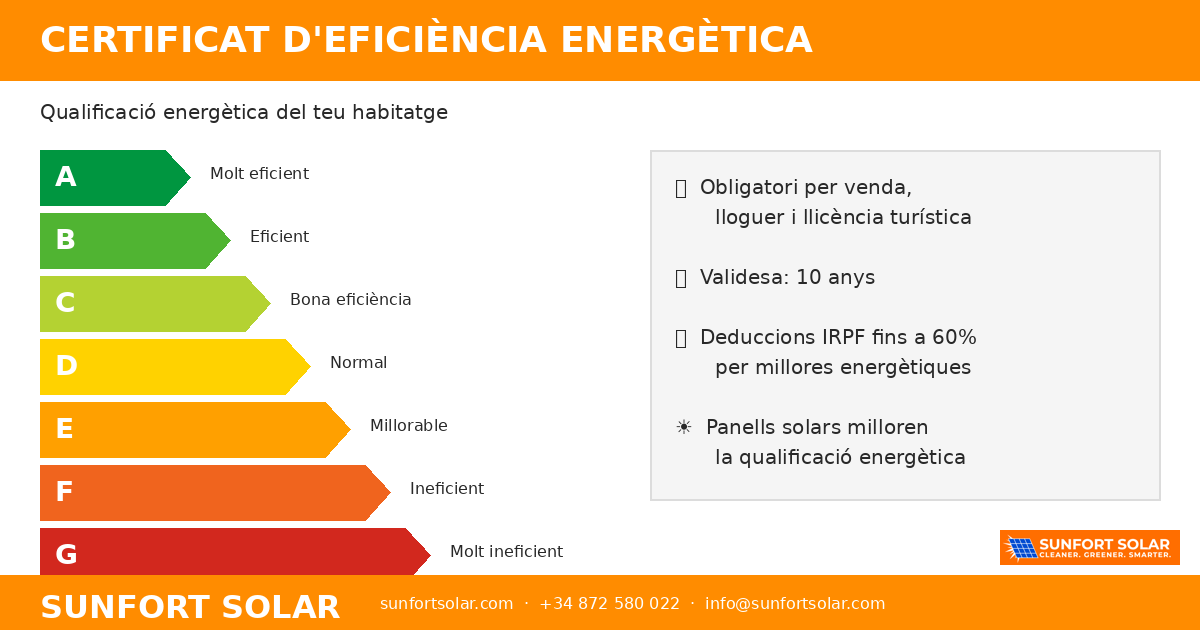
It’s important not to confuse the CIE with the Energy Efficiency Certificate (EEC):
- CIE: Certifies that the electrical installation is safe and complies with technical regulations
- EEC: Certifies the energy efficiency of the building (insulation, climate control, etc.)
They are two different certificates, with different purposes, and in many cases you’ll need both.
When is the CIE Mandatory?
The CIE is mandatory in the following situations:
1. Increase in Contracted Power
If you want to increase the power of your electricity contract, the distribution company (Endesa, e-distribución, etc.) will require an updated CIE.
Typical example:
- You have contracted 5.75 kW (standard 2.0TD tariff)
- You want to install solar panels + electric car charger
- You need to increase to 9.2 kW or more
- → CIE mandatory
This is one of the most frequent cases we see at Sunfort Solar.
Important: When you install solar panels or an electric car charger, you usually don’t need a complete new CIE, but rather a CIE extension of the existing installation. This is simpler and more economical than a new CIE from scratch.
Key Data for the Distribution Company
When you request a power increase, the distribution company needs this data from your CIE:
- Maximum power according to CIE - The maximum power your installation allows according to the last CIE submitted
- CIE issue date - When the certificate was issued
- Expiration date - Some CIE have validity periods depending on the installation type
- Access and extension rights - The rights you have to expand power without civil works
- Extension rights limit - Date until which these extension rights are valid
If the power you want to contract exceeds the maximum power according to CIE, it will be necessary to expand the installation and submit an updated extension CIE.
2. Substantial Changes to the Installation (CIE Extension)
Any major modification to the electrical installation requires a CIE extension:
- Expansion of the electrical panel
- Installation of new circuits
- Change of main wiring
- Installation of generation systems (solar panels, inverters)
- Installation of electric car chargers (wallbox)
- Modification of earth connection
In these cases, it’s not necessary to do a complete CIE of the entire installation, but only to certify the expansion or modification performed.
3. New Home or Comprehensive Renovation
If you build a new home or do a comprehensive renovation that affects the electrical installation, you need a CIE to be able to activate the supply.
4. Change of Ownership with Old Installation
If you buy or inherit a home with an electrical installation over 20 years old, many distribution companies require an updated CIE before accepting the change of ownership.
5. Installation of Charging Points for Electric Vehicles
The installation of an electric car charger (wallbox) with power exceeding 3.7 kW usually requires a CIE, especially if it involves modifications to the electrical panel.
6. Requirement from the Distribution Company
In some cases, the distribution company may require a CIE if they detect anomalies, excessive consumption or old equipment during their periodic inspections.
What Does the CIE Inspection Include?
To obtain the CIE, an authorized electrician (like Sunfort Solar) must perform a complete inspection of the electrical installation. The key points are:
1. Electrical Panel and Protections
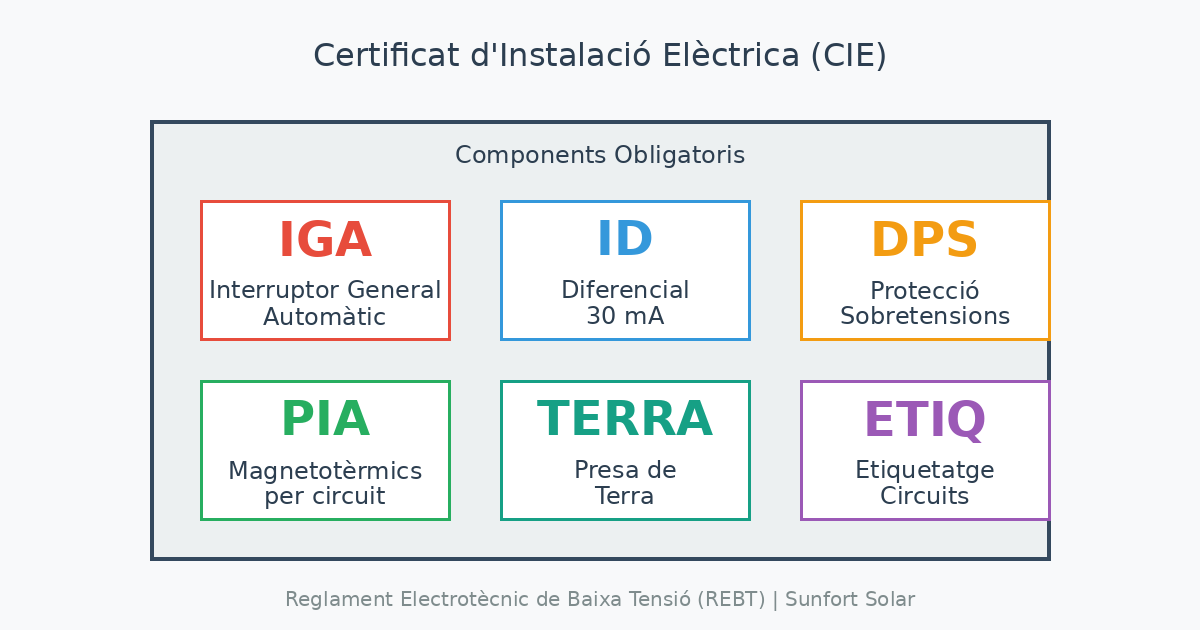
- Main Circuit Breaker (MCB): General protection of the installation
- Residual Current Devices (RCD): Minimum 30 mA for general use circuits
- Circuit Breakers: Individual protection for each circuit
- Surge Protection Device (SPD): Mandatory in certain cases (overhead networks, lightning rods, EV charging points)
- Labeling: All circuits correctly identified
Note: The power limiter is no longer mandatory, as current digital meters already integrate it.
2. Earth Connection
- Verification of earth resistance (< 20 Ω in homes)
- Continuity of protective conductor
- Correct connection to all sockets and metal equipment
3. Wiring and Conduits
- Cable section appropriate to power
- Wiring condition (without deterioration)
- Conduits correctly installed
- Standardized colors (phase, neutral, earth)
4. Sockets and Switches
- Power outlets with earth connection
- Switches in good condition
- Safety distances in wet areas (bathrooms, kitchens)
5. Lighting
- Light points correctly connected
- Adequate protection in wet areas (minimum IP ratings)
6. Special Equipment
- Air conditioning, heat pumps
- Fixed appliances (oven, ceramic hob)
- Generation systems (solar inverters)
7. Surge Protection Devices (SPD)
Surge protection devices are devices that protect the electrical installation from voltage spikes caused by lightning, network maneuvers or other disturbances.
According to ITC-BT-23 of the REBT, they are MANDATORY in:
- Installations fed by overhead networks - Type 1 SPD required at origin
- Buildings with lightning rods - Type 1 SPD required at origin
- Electric vehicle charging points - SPD required against transient and permanent surges (ITC-BT-52)
- Places of public assembly - According to ITC-BT-28
- Areas of high risk of atmospheric discharges
Recommended (not mandatory) in:
- New or renovated homes - Type 2 SPD in main panel
- Protection of sensitive equipment - Type 3 SPD near equipment (computers, TV, electronics)
SPD Types:
- Type 1: Protection against direct lightning (mandatory with lightning rods or overhead networks)
- Type 2: Protection against common transient surges (recommended in main panel)
- Type 3: Fine protection of sensitive equipment (recommended near delicate electronics)
Important: SPDs against permanent surges (for example, due to neutral rupture) are mandatory at electric vehicle charging points and highly recommended in installations with valuable equipment.
CIE Obtaining Process
Step 1: Hire an Authorized Installer
Only an authorized electrician (with installer license) can issue a CIE. At Sunfort Solar we are installers authorized by the competent authority and can manage the entire process.
Step 2: Installation Inspection
The electrician visits the home and performs a complete inspection of all the points mentioned above. This visit usually lasts 1-2 hours.
Step 3: Repairs if Necessary
If deficiencies or elements that don’t comply with regulations are detected, they must be corrected before issuing the certificate:
Common problems:
- 300 mA differential (must be changed to 30 mA)
- Absence of earth connection
- Cables with insufficient section
- Obsolete or in poor condition electrical panel
- Disorganized wiring without proper conduits
- Connections and splices outside the panel
- Missing protective cover
- Unlabeled circuits
Visual example: Electrical panel non-compliant with regulations
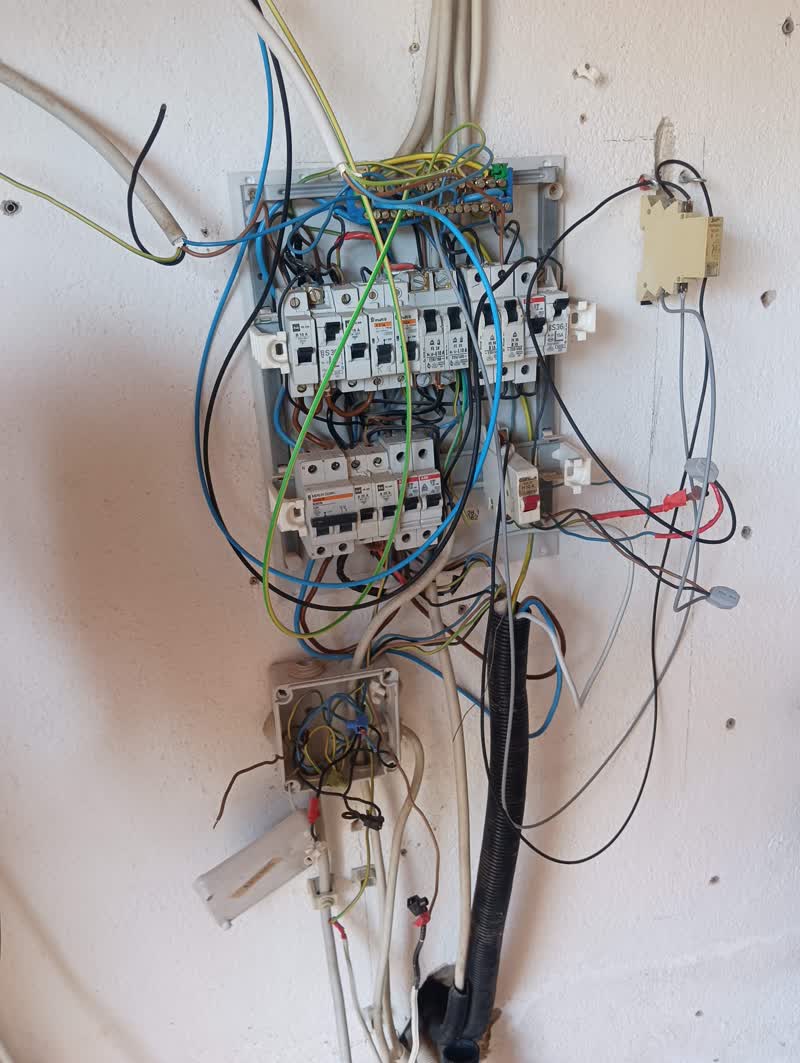
In the image above you can see an electrical panel that DOES NOT pass the CIE inspection. Note the multiple violations:
- ❌ Disorganized wiring without proper fastening
- ❌ Cables hanging freely without conduits
- ❌ Visible connections and splices outside the panel
- ❌ Panel without protective cover (electrocution risk)
- ❌ Impossible to identify circuits (without labeling)
- ❌ Improvised splices with inadequate section
This type of installation represents a serious risk to safety and requires a complete renovation before being able to issue the CIE.
Visual example: Acceptable but deficient electrical panel
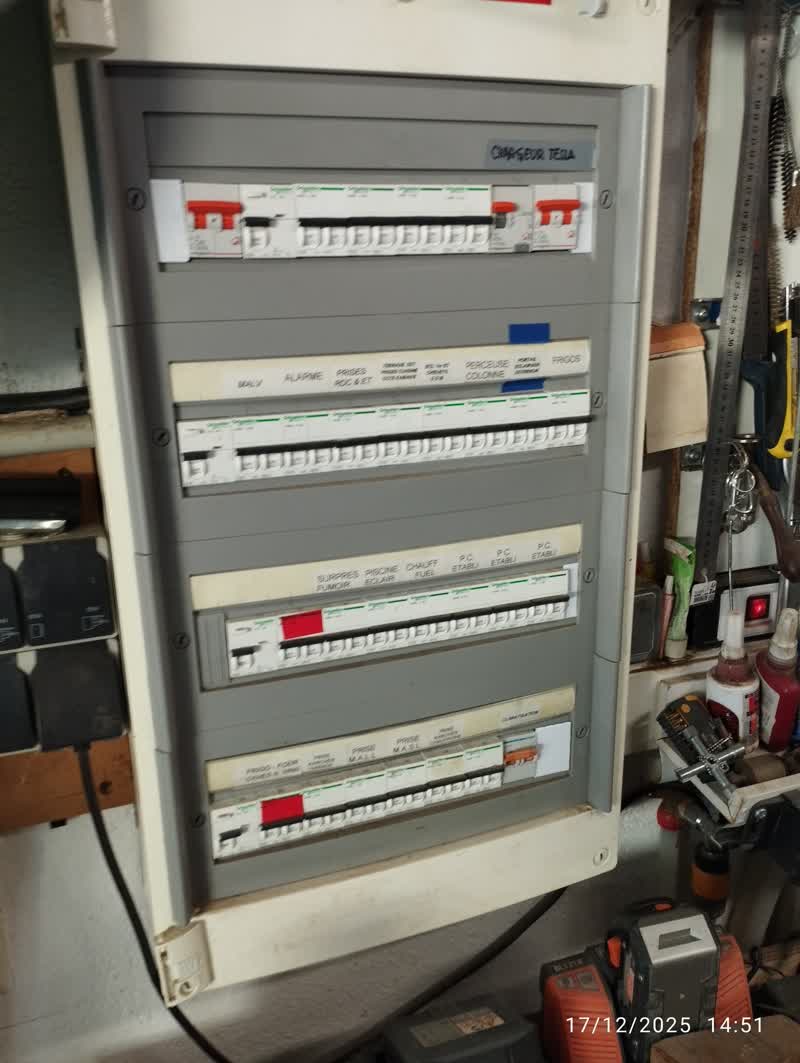
In contrast to the previous one, this panel is much better organized but still has deficiencies that prevent CIE approval:
What’s good ✅:
- Closed panel with cover (safety)
- Organized structure in rows
- MCB, RCDs and circuit breakers correctly mounted
- Organized wiring inside conduits
- Some circuits labeled
Deficiencies to correct ❌:
- Missing surge protection (SPD) - Mandatory for electric vehicle charging point according to ITC-BT-52
- Incomplete labeling - Several circuits not clearly identified
- Possible dedicated wallbox circuit without specific identification
This is a typical case of a panel that almost passes inspection but needs minor improvements. The cost of repairs would be much lower: between 200€ and 400€ (SPD installation + complete labeling).
Cost comparison according to panel condition:
- Panel in poor condition (first example): 800€ - 1,500€ (complete renovation)
- Acceptable panel with deficiencies (second example): 200€ - 400€ (specific improvements)
- Correct panel: 0€ (only CIE cost: 250€ - 400€)
Step 4: Preparation of Technical Report
The installer prepares a technical report (Type A or B document depending on complexity) that includes:
- Single-line diagram of the installation
- Power and cable section calculations
- Installation plans
- REBT compliance certification
Step 5: Submission to Competent Authority
In Catalonia, the technical report is submitted to ICAEN (Catalan Institute of Energy). In other autonomous communities, it may be to the corresponding industrial authority.
The procedure is done electronically and has an administrative cost of about 30-50€ (official fees).
Step 6: CIE Issuance
Once reviewed and approved, the competent authority issues the official Electrical Installation Certificate. The deadline is usually 1-2 weeks.
Step 7: Submit CIE to Distribution Company
If the CIE was needed for a power increase, the last step is to submit it to the distribution company along with the expansion request.
Case Study: Solar Installation with Power Increase
Initial situation:
- Single-family home in Empuriabrava
- Contracted power: 5.75 kW
- Electrical installation from 2005 (19 years)
- Client wants to install 10 kWp of solar panels
Analysis:
- Solar inverter requires connection to electrical panel
- Wallbox installation also planned (7.4 kW)
- Total power needed: minimum 9.2 kW
Sunfort Solar process:
Free initial inspection - We detect that the main RCD is 300 mA (must be changed to 30 mA) and a dedicated circuit for the wallbox is missing
Comprehensive quote:
- CIE + panel adaptation: 450€
- 10 kWp solar installation: 9,800€
- 7.4 kW Wallbox: 890€
- Total: 11,140€
Execution:
- Day 1: Electrical panel adaptation (RCD change, add circuit)
- Day 2: Inspection and CIE issuance
- Week 2: Submission to authority and power increase request
- Week 3: Approval and power increase
- Days 4-5: Solar and wallbox installation
- Day 6: Legalization and commissioning
Result:
- 100% legal and safe installation
- CIE issued and submitted
- Power expanded to 9.2 kW
- Solar and wallbox working correctly
- Client saves ~80% on electricity bill
Total time: 3-4 weeks
Indicative Cost of CIE
The price of the CIE depends on several factors:
| Concept | Indicative price |
|---|---|
| Basic CIE (no modifications) | 250-400€ |
| CIE with minor modifications | 400-800€ |
| CIE with complete panel renovation | 800-1,500€ |
| Official fees | 30-50€ |
Includes:
- Travel and inspection
- Technical report
- Electronic submission
- Management with competent authority
- Official certificate
Does not include:
- Material necessary for adaptations
- Repair labor
- Power increase (distribution company cost)
At Sunfort Solar we offer free quote after initial inspection, without obligation.
Common Errors and Penalties
Common Mistakes
❌ Increase power without CIE Many clients try to increase power without knowing they need the CIE. The distribution company will reject the request until they submit the certificate.
❌ Install solar without legalizing Some “pirate” installations are done without CIE or technical report. Besides being illegal, it can cause:
- Disconnection of supply
- Loss of equipment warranty
- Problems with home insurance
- Impossibility to sell the home
❌ Use unauthorized installers Only an electrician with installer license can issue a valid CIE. Certificates from unauthorized companies have no legal validity.
❌ Reuse old CIE A CIE has limited validity. If you’ve made modifications after certificate issuance, it becomes invalidated and a new one must be issued.
Penalties for Non-Compliance
Royal Decree 842/2002 establishes penalties for non-compliance with electrical regulations:
Minor infractions: 200€ - 2,000€
- Lack of updated documentation
- Minor errors in installation
Serious infractions: 2,001€ - 6,000€
- Absence of CIE in mandatory situations
- Modifications without legalization
- Non-compliance with safety distances
Very serious infractions: 6,001€ - 24,000€
- Serious risk to people
- Recidivism in serious infractions
In addition, in case of accident or fire, the absence of CIE can lead to:
- Civil and criminal liability
- Insurance refusal to cover damages
- Problems in property sale
Why the CIE is So Important
Beyond legal obligation, the CIE has real benefits:
1. People’s Safety
A deficient electrical installation can cause:
- Electrocutions
- Fires due to overload or short circuit
- Damage to appliances
The CIE guarantees that the installation meets safety standards.
2. Equipment Protection
Adequate protections (RCDs, circuit breakers) prevent damage to:
- Expensive appliances
- Air conditioning systems
- Sensitive electronic equipment
- Solar inverters
3. Legal Peace of Mind
With the CIE in order:
- You won’t have problems with the distribution company
- You can sell the home without impediments
- Insurance will cover electrical damages
- You avoid administrative penalties
4. Better System Performance
A well-dimensioned and protected installation works better:
- Fewer power cuts
- Fewer problems with power limiter
- Greater energy efficiency
Sunfort Solar: Your Authorized Installer
At Sunfort Solar we are authorized installers and can manage the entire CIE process:
✅ Free initial inspection - We visit your home without obligation
✅ Clear and detailed quote - No surprises
✅ Repairs if necessary - Quality materials and workmanship
✅ Complete processing - We take care of everything with the competent authority
✅ Follow-up with distribution company - If you need power increase
✅ Integrated solar installation - If you want solar panels, we do everything in one project
Proven experience: More than 200 CIE issued and legalized successfully.
Frequently Asked Questions
How long does the entire process take? Between 1-2 weeks if there are no repairs. If modifications are needed, it can extend to 3-4 weeks.
Does the CIE expire? It has no expiration date, but it becomes invalidated if you make substantial modifications to the installation after issuance.
Can I do it myself if I’m an electrician? Only if you have the official authorized installer license. Being an electrician is not sufficient to issue CIE.
Is the CIE mandatory to rent a home? It’s not mandatory to rent, but it’s recommended. In case of accident, the owner may have responsibilities if the installation doesn’t comply with regulations.
What happens if I don’t have earth connection? It’s a serious deficiency that must be corrected. The installation of an earth connection costs between 300€ and 600€ depending on the building type.
Is the CIE valid throughout Spain? Yes, the REBT is state regulation. The certificate issued in Catalonia is valid throughout Spanish territory.
Conclusion
The Electrical Installation Certificate (CIE) is not just a bureaucratic procedure, but a safety guarantee for your home and your family.
If you’re thinking about:
- Increasing contracted power
- Installing solar panels
- Installing an electric car charger
- Doing a renovation that affects the electrical installation
You’ll need a CIE. And it’s best to do it right from the start, with an authorized installer like Sunfort Solar.
Don’t wait for the distribution company to request the certificate or, worse yet, to have an electrical problem. Acting preventively can save you troubles and money.
Request Your Electrical Installation Certificate
At Sunfort Solar we offer a free initial inspection and a quote without obligation. We are authorized installers and manage the entire CIE process: inspection, repairs if necessary, technical report, submission to competent authority and follow-up with the distribution company.
📞 Prefer to call? +34 872 580 022 📧 Or write to us: info@sunfortsolar.com