Solar panels and a battery: how much contracted power do you really need?
Solar panels and a battery: how much contracted power do you really need?
A question we hear a lot once the panels and battery are in: “Now that I make my own electricity, can I lower my contracted power?” Picture a holiday home in Empuriabrava with an air-to-water heat pump, an induction hob and an EV charger, on a 9.9 kW contract that was set years ago “just in case”. It may be too much, or it may not. The answer isn’t on the inverter’s label; it’s in your consumption data.
Here’s how to decide with real numbers, and what to know before you ask for a change.
Contracted power caps what you draw from the grid
In Spain, contracted power (potencia contratada) is the most you can draw from the grid at any moment. Your smart meter keeps an eye on it: go over it for long enough and it cuts the supply until it resets. You pay the power charge every month for each contracted kW, whether you use it or not.
Solar panels help, but only while the sun shines. At seven on a January evening, with the battery empty, the whole house runs on the grid, and that’s when you find out whether your power is enough. That’s why contracted power is sized for the worst moment, not for a summer midday.
There’s another ceiling: you can’t contract more than the maximum admissible power stated on the house’s electrical certificate (the CIE, or boletín). If you need more, the installation has to be checked first, and often a new certificate issued.
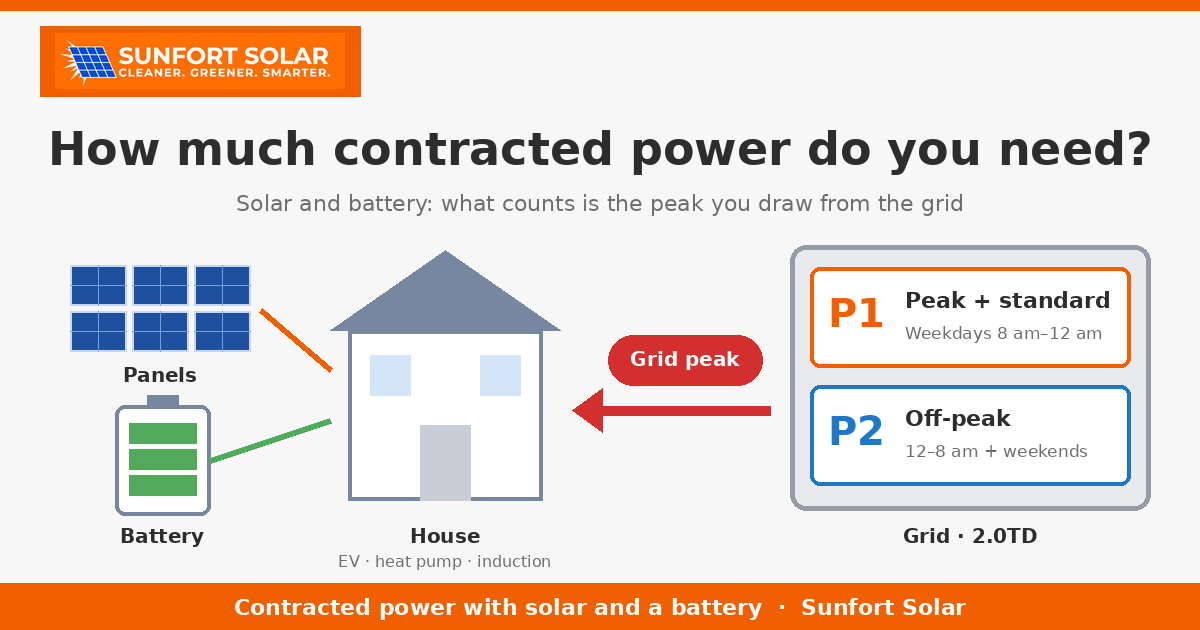
Two power levels: P1 and P2
Since June 2021, homes and small businesses (up to 15 kW) are on the 2.0TD access tariff, which lets you contract two power levels separately:
- P1 (peak and standard): weekdays, 8 am to midnight.
- P2 (off-peak): weekdays, midnight to 8 am, plus weekends and national holidays all day.
P2 is much cheaper than P1. So you could, for example, keep P1 tight for the daytime and set P2 higher for charging the car overnight. Power can be chosen in steps of 0.1 kW.
What drives the peaks (and what can bring them down)
In a modern home, the peaks come from a few big loads:
- The EV charger: a 32 A single-phase charger can draw around 7.4 kW for hours.
- The heat pump, especially if it has a backup heater, and the pool heat pump.
- The induction hob and the oven, which tend to run together at dinner time.
When they overlap, the total tops your contracted power in an instant. A charger with dynamic load management (it throttles charging when the house uses more) avoids most trips without raising your power.
And the battery? It only trims grid peaks if it’s set up to do so. Most batteries discharge to cover the house load, but only up to the discharge power of the battery and inverter. If the inverter delivers 5 kW and the house asks for 11, the other 6 still come from the grid. If the battery is set to charge from the grid at night, that charging adds to your P2 peak. And an empty battery after a cloudy day doesn’t help at all. Before lowering your power on the strength of the battery, check how the inverter is configured.
How to find your real peak
No need to guess. There are three sources:
- Your bill. Your supplier has to show the maximum power demanded over the last year, for P1 and P2.
- Datadis or your distributor’s customer area. Datadis (datadis.es) is the free platform run by the distribution companies: you can see hourly consumption and maximum power demanded.
- Your inverter’s monitoring app. If there’s a meter at the grid connection, you can see how much power you import through the day and which appliances push it up. Bear in mind that many apps average over 5 minutes and can hide short peaks.
Look at a full year if you can: summer and winter in a holiday home are very different.
Changing it: once every 12 months, and raising costs more than lowering
You ask your electricity supplier, who passes the request to the distributor. Royal Decree 1164/2001 (article 5.4) requires the distributor to make the change unless you have already changed it voluntarily within the last 12 months. So if you get it wrong, you may have to wait a year to fix it.
The costs aren’t symmetrical either. According to the CNMC (the Spanish energy regulator) table based on Order ITC/3519/2009, for low-voltage supplies:
- Lowering your power: only the meter work fee (derechos de actuación), about €9.04 plus VAT.
- Raising it: on top of that fee, access rights (about €19.70/kW) and extension rights (about €17.37/kW), plus VAT, for every kW you add. If you already had that power within the last three years, the extension rights are usually not charged again.
Check the exact amount with your distributor before you apply (on the Costa Brava it’s often e-distribución). The practical lesson: lower your power carefully rather than having to raise it again.
Surplus compensation doesn’t pay the power charge
Under simplified compensation (Royal Decree 244/2019, article 14), the energy you export is deducted from the energy you buy. But there’s a cap: the value of your surplus can never exceed the value of the energy you drew from the grid in that billing period, which is one month at most. Anything above that is lost, and the power charge, meter rental and taxes are never offset.
That’s why, in a house with lots of surplus, the summer bill can come down to little more than the power charge. And that’s where getting your contracted power right pays off every month, all year round.
An example of how we look at it
Back to the Empuriabrava house. If a year of data shows the daytime peak stays below about 5.5 kW and the night-time peak, with the car charging, reaches about 8 kW, a sensible choice might be a P1 of around 6–7 kW and a P2 of around 8.5–9 kW, with the charger limited so it doesn’t stack on top of the cooking. The exact figures depend on each house; the method is always the same: a year of data, the battery and charger settings, and a small margin.
At Sunfort Solar we review contracted power whenever we design a solar and battery system in the Alt Empordà. Get in touch and send us a recent bill: we’ll tell you whether your contracted power is right before you request any change.