Battery with backup: why we always recommend it (and what happens in a power cut)
Battery with backup: why we always recommend it (and what happens in a power cut)
It is one of the conversations we have most often: “If I get a battery, I’ll still have power when the grid goes down, right?” The honest answer is: it depends on how it is installed. A battery without backup switches off in a power cut, just like the rest of the house. Most people only find out at the first outage, with a full battery and a fridge that has stopped.
That is why at Sunfort Solar we made a simple decision: every battery system we install includes backup, in other words a dedicated backup circuit. Here is why, how it works and what you need to decide.
Why a battery without backup shuts down in a power cut
A grid-connected inverter has a safety rule it cannot break: if the grid goes down, it must disconnect. This is known as anti-islanding protection, and it makes perfect sense. When there is a fault on the line, the utility’s engineers work on the assumption that the cable is dead. If thousands of inverters kept feeding power into it, they would be put at risk.
Without a backup circuit, the inverter has no way of separating the house from the grid. So it does the only safe thing it can: it shuts down completely. The battery may be at 100 %, but that energy stays locked away until the supply returns. The panels stop producing too.
This is not a fault in the equipment. The system simply was not designed to run on its own.
What backup actually is
Backup is a separate output on the inverter, usually wired to its own small consumer unit with the circuits you want to keep running. When the grid fails, an automatic changeover disconnects the house from the grid and the inverter starts supplying those circuits from the battery and the panels. When the grid comes back, it reconnects everything by itself.
A few points are worth understanding:
Switchover time. Some hybrid inverters work in “UPS-style” mode, switching over so quickly that you barely notice: the lights don’t flicker and the computer doesn’t restart. Other systems take a few seconds to restore power. For a fridge or a pump, a few seconds make no difference; for a server or sensitive equipment, they might. It is something to check on each unit’s data sheet.
Backup output power. The backup output has a limit, which is sometimes lower than the inverter’s rated power. If you connect more load than it can handle, the system protects itself and shuts down. So having backup is not enough: you need to choose carefully what goes on it.
How long it lasts. That depends on the battery capacity and on what you use. A fridge, a few lights, the router and the alarm draw very little, and a normal home battery can keep them going for many hours. Add large appliances and the battery empties much faster.
A power cut with and without backup
Without backup: the grid fails, the inverter shuts down and the house goes dark. The battery and the panels are useless until the power returns. If the outage happens in summer and lasts for hours, the freezer will feel it.
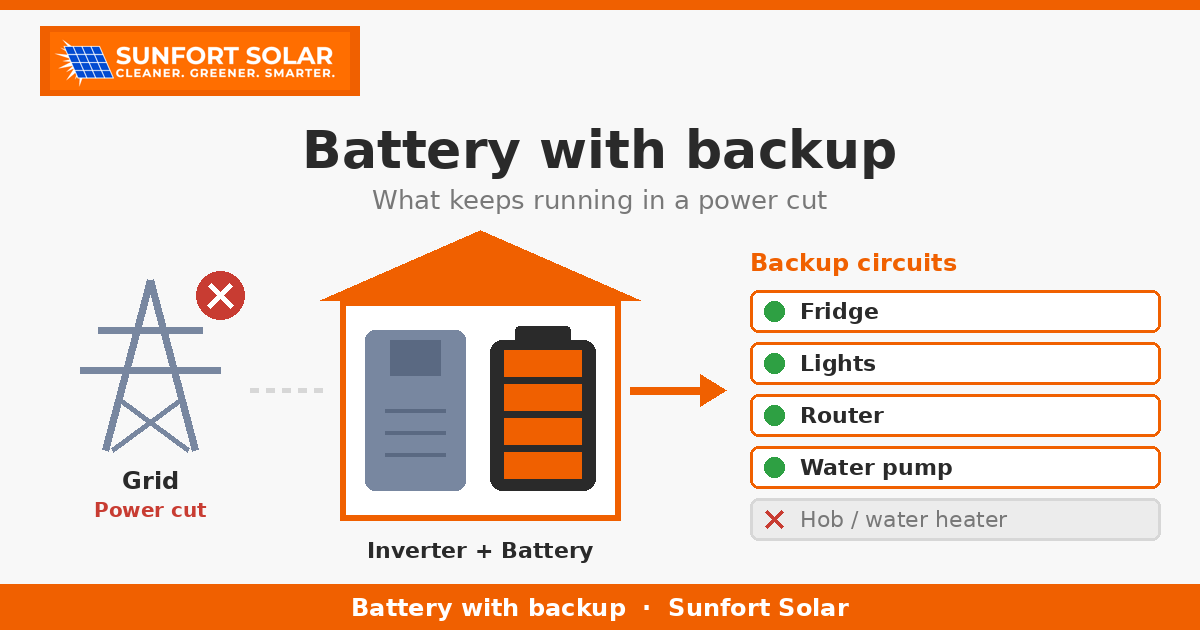
With backup: the grid fails, the system disconnects from the line and the essential circuits keep running. The fridge stays cold, the router keeps the internet on, the alarm stays armed and, if you have a well or a pressure pump, water still comes out of the tap.
There is also an advantage many people don’t know about: with backup, the panels can keep producing during the day and recharge the battery even while the grid is down. In a long outage, that is the difference between lasting a few hours and lasting several days on moderate consumption. (The inverter has to support it; with common hybrid units it is standard, but we check it in every case.)
What you need to decide
When we design a battery system, we ask you three questions:
- Which circuits you want to keep. The usual ones are the fridge and freezer, some of the lighting, the sockets for the router and computer, the alarm, the garage door and, if you have them, the water pump or the boiler (its electrical part). We make a short, well-thought-out list.
- How much power you need. We add up what might run at the same time and compare it with what the backup output can handle, leaving a margin for the start-up surges of motors such as the fridge or the pump.
- Whether you want the whole house. Whole-house backup is possible, but it needs a larger inverter and battery, and in practice it means learning not to switch everything on at once during an outage. For most homes, a well-chosen set of essential circuits gives 90 % of the peace of mind with far less complexity.
Common mistakes
Assuming the battery alone protects you. This is the most common mistake and the reason for this article. If your system has a battery and you don’t know whether it has backup, ask the installer, or test it by switching off the main breaker (carefully, and with a technician if you are unsure).
Putting the induction hob or the electric water heater on it. These are the biggest consumers in a home. On the backup circuit, during an outage they can exceed the output’s limit and shut everything down, or drain the battery in no time. Without them, everything else lasts much longer.
Adding air conditioning without doing the maths. A heat pump or air conditioner can run on backup, but it has to be sized for it specifically. Adding it “just in case” is usually a bad idea.
Never testing it. Once it is installed, it is worth doing a controlled test: cut the grid supply and check that the essential circuits keep working, and that everyone at home knows what is connected and what isn’t.
Our recommendation
If you get a battery, get backup with it. The extra cost is small when it is done from the start, and adding it later is usually more complicated. A battery that only works while the grid is up does half the job it could do.
At Sunfort Solar we design and install self-consumption systems with batteries in the Alt Empordà, always with a backup circuit, and we also check existing systems to see whether backup can be added. Get in touch and we’ll work out together which circuits you want to keep running.