Adding a battery to the solar installation you already have: Huawei, Deye or a separate system?
Adding a battery to the solar installation you already have: Huawei, Deye or a separate system?
We get more and more calls like this one: “I had solar panels fitted a few years ago, but without a battery. Now I can see that in the evening and at night I buy almost all my electricity from the grid. Can I add a battery?” The short answer is almost always yes. The longer answer is that there are several ways to do it, and the best one depends mainly on one component: the inverter you already have.
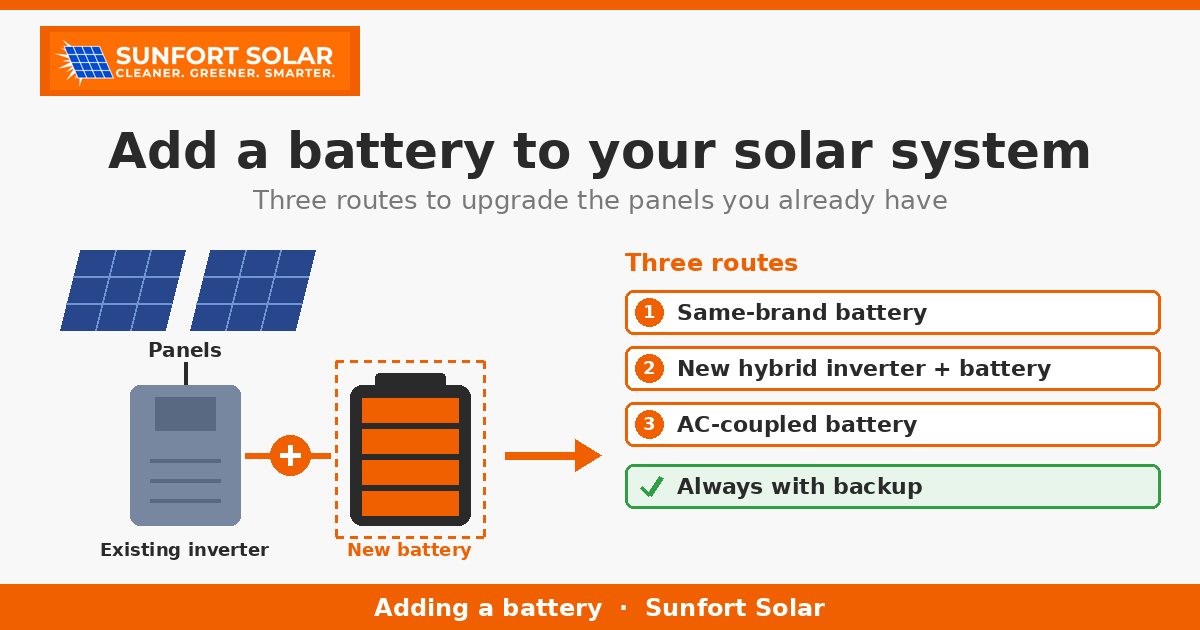
Today we explain the three routes we use, the pros and cons of each, and how to work out what battery size makes sense for your home.
Step one: which inverter do you have?
Before talking about batteries, take a look at the inverter’s label. There are two broad families:
- Hybrid or battery-ready inverters. They have an input for a battery, even if none is connected today. Many current residential models, for example a large part of Huawei’s home inverters, are of this type.
- Grid-only inverters. They convert the energy from the panels and send it to the house and the grid, but they have no battery input. Microinverters, one per panel or per pair of panels, also fall into this group.
If you don’t know which model you have, a photo of the label on the unit is enough.
Route 1: a battery compatible with your existing inverter
If your inverter is hybrid, the most direct option is to add a battery that the manufacturer has approved for that model. The typical example is a Huawei hybrid inverter with a Huawei LUNA2000 battery: they connect to each other, the inverter recognises the battery and everything shows up in the same app.
Pros:
- Simple, clean integration: one inverter, one app, one brand to deal with under warranty.
- The panels charge the battery directly, with no extra conversions.
- No need to touch the panel side or replace the main equipment.
Cons:
- Branded batteries tend to cost more than other lithium alternatives with similar capacity.
- You depend on the manufacturer’s compatibility list: you can’t connect just any battery.
- Depending on the model, backup requires an additional module or a dedicated panel. We check this before quoting.
This is the route we recommend when the inverter is fairly recent, works well and the owner values simplicity over price.
Route 2: replace the inverter with a new hybrid one
When the current inverter isn’t hybrid, is already several years old, or the branded battery simply doesn’t add up, an alternative is to replace the inverter with a new hybrid model and add a lithium battery. One combination we install often is a Deye hybrid inverter with FelicityESS lithium batteries.
Pros:
- New equipment, with a new warranty, ready for battery and backup from day one.
- More freedom in choosing the battery and, often, a lower cost per kWh of storage.
- A good opportunity to renew an inverter that is nearing the end of its service life.
Cons:
- You remove a unit that may still work. If it’s fairly new, it isn’t always worth it.
- The existing panels must be checked against the new inverter (string voltages and currents). They usually fit, but it has to be calculated.
- It’s a modification of the installation, and its paperwork and registration may need to be updated.
Route 3: an AC-coupled battery system
The third option is to leave everything you have untouched and install a separate battery system alongside it, with its own inverter, connected to the home’s distribution board. This is called AC coupling. The system measures when the house is exporting surplus energy to the grid and, instead of letting it go, stores it in the battery for later use.
Pros:
- Works with virtually any installation, including microinverters and non-hybrid inverters.
- The current inverter keeps working as before, with its warranty intact.
- Lets you expand without dismantling anything, and stays flexible if you add more panels later.
Cons:
- One more device in the house, taking up space and with its own app.
- The energy is converted more times (DC to AC and back), which means slightly higher losses than with a directly connected battery.
- Backup is possible, but during a power cut the old inverter shuts down for safety. Whether the panels can keep recharging the battery during the outage depends on how the whole system is designed, and has to be assessed case by case.
Our rule: every battery comes with backup
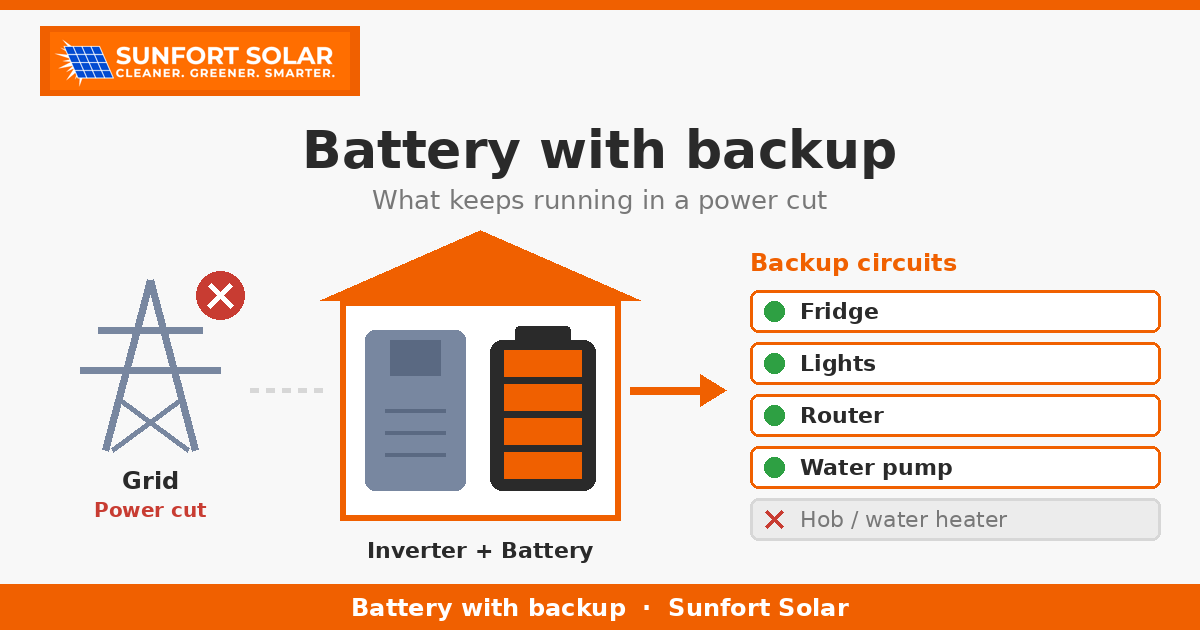
Whichever route you choose, at Sunfort Solar every battery we install comes with a backup circuit. A battery without backup shuts down in a power cut just like the rest of the house, even when it’s full. With backup, the fridge, lights, router or water pump keep running. We cover this in more detail in our blog article on batteries with backup. In a retrofit, backup is also planned from the start.
How to choose the battery size
The most common mistake is to go by your contracted power. It has little to do with what you need. The useful figures are already in your installation’s app:
- Night-time consumption. Look at how much energy the house uses from sunset to sunrise over a few ordinary days. That is roughly the share a battery can cover.
- The energy you export to the grid. This is what you have left over during the day today and could store. If you export little, a large battery will never fill up.
- Seasonality. In summer there is plenty of surplus; in winter, much less. It’s worth looking at more than one month before deciding.
A sensible size is one that fills up with the surplus of an ordinary day and covers a good part of the night-time consumption. Beyond that, you pay for capacity you will hardly use. If your app only shows production and not household consumption, a consumption meter is probably missing, and installing one is already a useful first step.
Common mistakes
- Buying the battery before checking the inverter. Compatibility decides almost everything.
- Forgetting about space and ventilation. Lithium batteries need a sheltered spot, out of direct sun and accessible for maintenance.
- Leaving backup for later. If it isn’t planned now, it costs more afterwards.
Our recommendation
No single route is best for everyone. If you have a recent hybrid inverter, a compatible battery is usually the cleanest solution. If the inverter isn’t hybrid or is getting old, it’s worth comparing a new inverter with an AC-coupled system. And in every case, the size is decided with the data from your app, not from your bill.
At Sunfort Solar we review existing installations in the Alt Empordà to find the most sensible way to add a battery, always with backup. Get in touch, send us a photo of your inverter’s label and a few screenshots from your app, and we’ll tell you what your options are.